 Minnesota Legislature
Division hears bill to save students from abrupt college closures
When Argosy University abruptly went out of business last spring, the state’s Office of Higher Education quickly shifted into EMT mode. Like paramedics at the scene of a massive multi-vehicle accident, the agency scrambled to save the academic careers of students enrolled in the suddenly shuttered institution, which was particularly known for training prospective health professionals.
But the office, which is responsible for administering state financial aid programs, would take on another role under a bill heard by the House Higher Education Finance and Policy Division Wednesday: that of a police force entrusted with preventing such crashes.
Sponsored by the division chair, Rep. Connie Bernardy (DFL-New Brighton), HF4553 would increase the office’s punitive capabilities and allow it to require more financial transparency from post-secondary institutions.
The bill, which has no Senate companion, was laid over for possible inclusion in a larger higher education bill.
The proposal is an attempt to answer a question frequently asked amid testimony from tearful former Argosy students last session: How can we keep this from happening in the future?
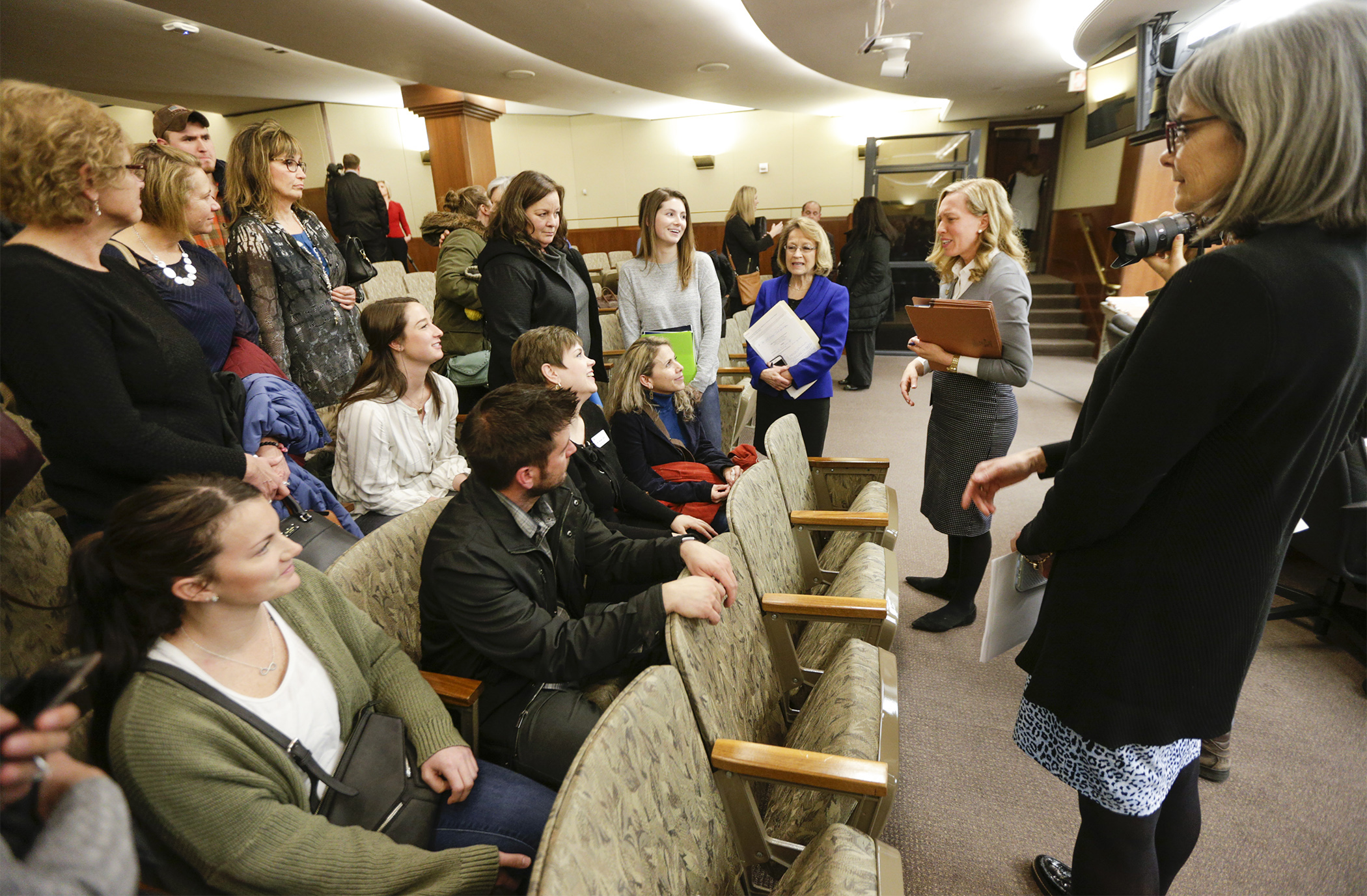 Reps. Ginny Klevorn, from right, Heather Edelson and Linda Runbeck talk with former students and faculty of Argosy University, which closed abruptly in March 2019, following an April 2019 committee hearing. House Photography file photo
Under the bill, the Office of Higher Education would oversee an expanded list of requirements for schools to remain licensed in the state, open them up to more financial scrutiny, and require the agency to conduct risk analysis.
Among potential punishments for institutions deemed at risk for “precipitous closure” would be limiting access to state financial aid, expanding schools’ financial responsibility in the purchase of surety bonds, and prohibiting them from enrolling new students or accepting tuition. It would also allow the office to seek reimbursement from a school for costs related to its investigations, including responding to student complaints.
Betsy Talbot, the Office of Higher Education manager of institutional registration and licensing, said college closures in Minnesota have increased significantly in recent years: There have been 33 since 2016.
In answer to a question from Rep. Linda Runbeck (R-Circle Pines), Talbot laid out how Argosy violated several provisions in state law that would be strengthened under the bill. In particular, she said that Argosy did not maintain its bond or provide required notices and documentation, and that it misappropriated state funds earmarked for student financial aid, using them for payroll and technology expenses.
Bernardy spoke of the bill’s strong bipartisan support. “I’m sure that I’m not the only one who was moved by the testimony at our hearing on April 10, 2019. That day, 20 former Argosy students showed up in the middle of a blizzard to testify and ask us for help. And to make sure that what happened to them won’t happen to other students in the future. I don’t want to ever have another hearing like that. I urge you to remember them and vote in favor of this.”
Related Articles
Search Session Daily
Advanced Search OptionsPriority Dailies
Legislative leaders set 2026 committee deadlines
By Lisa Kaczke Legislative leaders on Tuesday officially set the timeline for getting bills through the committee process during the upcoming 2026 session.
Here are the three deadlines for...
Legislative leaders on Tuesday officially set the timeline for getting bills through the committee process during the upcoming 2026 session.
Here are the three deadlines for...
Latest budget forecast projects nearly $2.5 billion surplus, but red ink down the road
By Mike Cook Three weeks before Christmas, state budget officials provided some merriment to Minnesotans. However, Grinch-like transformations lurk.
Released Thursday, the November ...
Three weeks before Christmas, state budget officials provided some merriment to Minnesotans. However, Grinch-like transformations lurk.
Released Thursday, the November ...
