 Minnesota Legislature
Panel finds no probable cause to support ethics complaints
— UPDATED at 4:30 p.m.
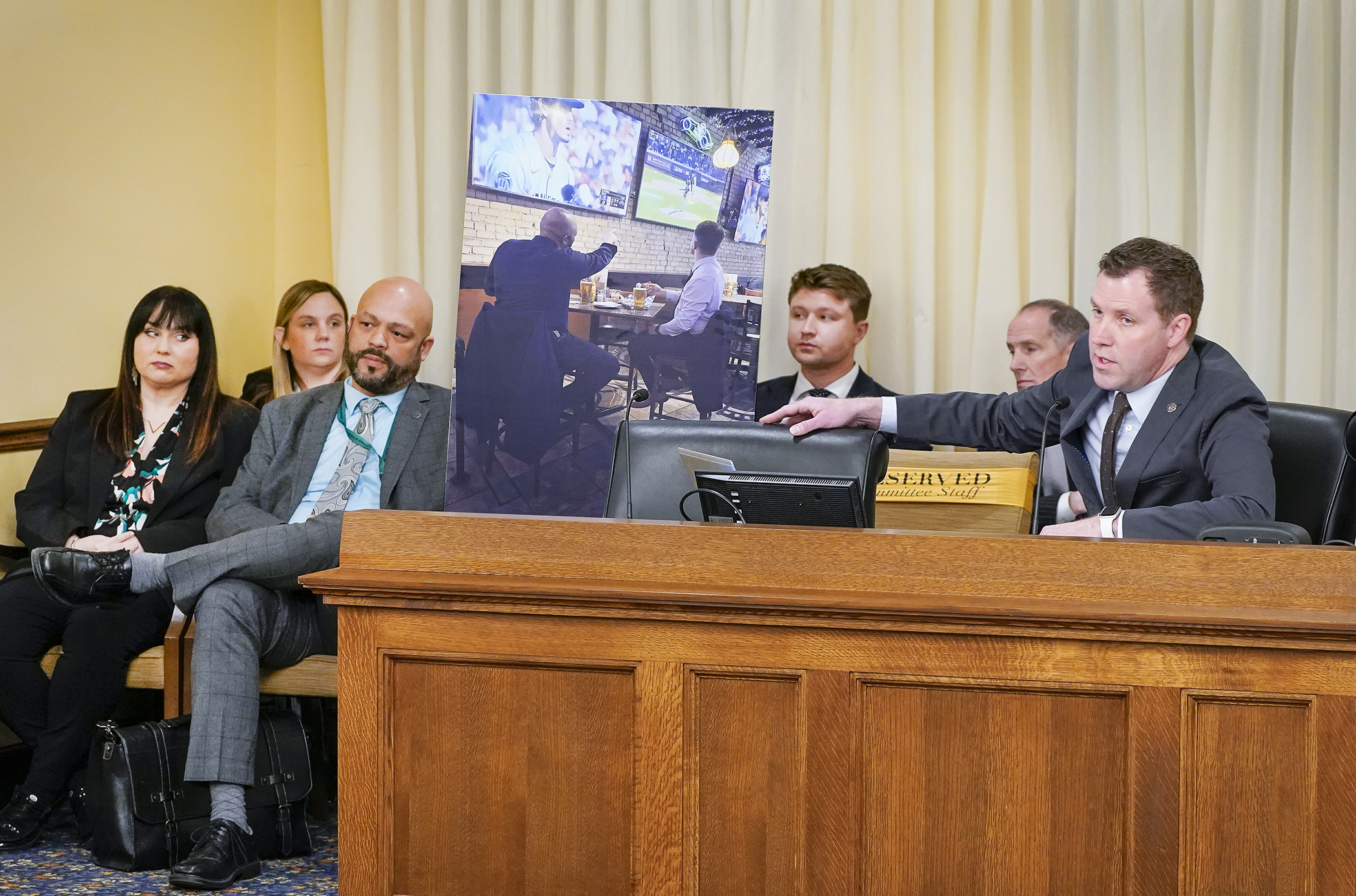
The House Ethics Committee heard competing DFL and Republican complaints Friday alleging that two members left a committee meeting to drink at a St. Paul restaurant and another member worked as a lobbyist while he served as a legislator.
Following hours of testimony in open session, Committee Co-Chair Rep. Greg Davids (R-Preston) said the committee had a “thorough discussion” in an executive session closed to the public.
The committee unanimously voted in the closed session that there wasn’t probable cause to support a complaint against Rep. Elliott Engen (R-Lino Lakes) and Rep. Walter Hudson (R-Albertville) and there wasn’t probable cause to support a complaint against Rep. Alex Falconer (DFL-Eden Prairie), according to Davids.
The complaints allege the three members violated House rules: Engen and Hudson by allegedly leaving a committee meeting early to go to a restaurant, and Falconer by allegedly working as lobbyist while serving as a legislator.
However, regarding the complaint against Engen and Hudson, all four ethics committee members signed a statement to clarify expectations and norms of behavior under House rules.
The statement read:
“House members are expected to attend assigned committees unless excused, do the work of the committee, and treat testifiers with dignity and respect. It is incumbent upon members to bring honor to the body and to uphold the public trust."
Before the probable cause hearings got underway, Davids provided a reminder that the panel is “not a court of law,” but rather an internal mechanism allowing House members to hold one another accountable between elections.
“Ultimately, accountability rests with the voters,” he said.
Complaint against Engen, Hudson
A complaint against Engen and Hudson charges them with “leaving in the middle of their appointed committees to go drinking instead.”
The lawmakers responded that leaving an informational committee hearing to have a burger and a beer not only doesn’t violate any House rules, but falls well within common and normal actions during a legislative day.
Evidence of the complaints, brought by House DFL Floor Leader Jamie Long (DFL-Mpls) and Rep. Samantha Sencer-Mura (DFL-Mpls), included videos showing both Engen and Hudson absent for the last half of a March 26 House Education Finance Committee meeting.
Also submitted as evidence, a photo posted on social media of the representatives at a St. Paul restaurant with beer glasses, empty cocktail glasses and the Twins season opener on in the background, allegedly to be taken about 2:30 p.m.
“Committee is where the bulk of our work gets done,” Long said, adding that a nurse, teacher or retail worker would face consequences for leaving work to have a drink.
The complaint also questioned the members’ levels of intoxication during a floor session that day, which convened at 3:30 p.m.
We “cannot send a message that this is acceptable behavior and it can’t happen again,” Long said.
Engen’s response
Engen acknowledged he left the committee hearing, but said he asked questions before leaving and didn’t miss a vote. When he decided the hearing had become unproductive, he left to use the bathroom, call his wife, and charge his phone, before having lunch with a fellow House member.
Engen also referenced his DWI arrest later that night, expressing “remorse, shame, and regret,” but that he did nothing unethical during the day.
“I won’t be characterized as a lazy legislator. I take my job very seriously,” he said.
Hudson’s response
Hudson called the complaint “utterly absurd in premise, speculation and evidence.”
He took specific issue with the complaint raising the question of whether he had violated state law by carrying a firearm while over the legal blood alcohol concentration of 0.04%, stating that there was no evidence he had a gun while on the House Floor that evening. Additionally, though not conceding he had more than a beer, he said even if he had a cocktail, he would be well below the legal limit to carry a firearm as a man of his size.
He said the complaint assumes a norm of perfect attendance for every member every second of every committee meeting, and no member should consume alcohol during the legislative day. Neither, he argued, is an established or consistently enforced standard, citing multiple examples of both happening, and that the complaint is one of the most frivolous ever filed.
Complaint against Falconer
A complaint filed by Rep. Spencer Igo (R-Wabana Township) and Rep. Isaac Schultz (R-Elmdale Township) alleges that Falconer violated rules that prohibit any member of accepting compensation for lobbying. This is related to Falconers’ position as a senior advisor the Northeastern Minnesotans for Wilderness.
Igo said the issue is role overlap, and state statute makes clear that acting in the capacity of a lobbyist is prohibited, regardless of registration status.
Conduct counts, not labels, he said.
Evidence provided by Igo and Schultz shows that Falconer had been a registered lobbyist for the NMW and was listed on a website as a federal government relations manager.
It also includes a bill sponsored by Falconer that is supported by the NMW and an email to federal officials regarding protections to the Boundary Waters Canoe Area Wilderness.
Igo said the question before the committee is if a sitting legislator can accept compensation for performing government relations or lobbying functions.
Falconer’s response
“One thing is clear, I am not a lobbyist,” Falconer said. “I was, yes, but that ended.”
Falconer takes a leave of absence from his job when the House is in session and his only compensation was from paid time off during his first legislative session. His job as a senior advisor varies, but includes community education, community organizing, attending conferences, buying laptops and taking water samples.
Falconer’s attorney, David Zoll, said the complaint should be dismissed because Falconer is not a lobbyist and is not required to register as a lobbyist based on the work he does.
“He’s not here to carry the water for Save the Boundary Waters. He’s here to represent the voters that elected him,” Zoll said, adding the voters understand his deep personal connection to the Boundary Waters and support his advocacy on the issue.
Zoll said the complainants’ assertions would mean no House member could advocate for issues related to their job outside the Legislature, such as sheriffs on law enforcement bills or teachers on education bills.
Related Articles
Search Session Daily
Advanced Search OptionsPriority Dailies
Could 2026 retirements lead to record turnover in the House?
By Lisa Kaczke In the final weeks of the legislative session, House members not seeking re-election to the body have taken a turn at gaveling in a floor session.
It’s an opportunity to loo...
In the final weeks of the legislative session, House members not seeking re-election to the body have taken a turn at gaveling in a floor session.
It’s an opportunity to loo...
How short are the Legislature's short sessions?
By Lisa Kaczke Rep. Ron Kresha (R-Little Falls) was ready to end the session March 25, making the motion to adjourn sine die. But not enough of his colleagues shared that sentiment, defeating ...
