 Minnesota Legislature
Rural utilities with large-scale users could avoid ECO requirements
Say you’re a relatively small utility in a rural area of Minnesota, the kind of power provider run by a city or a cooperative of local residents. What would you do if a company made plans to open a large-scale data center within your service area? And what if that data center’s electricity demands would double or even triple your utility’s current output?
This scenario has played out in the state, with one example found in the south-central town of Glencoe. A crypto-based data mining operation has set up shop near town, securing its electricity from a municipal utility, Glencoe Light and Power.
While the utility’s general manager, Dave Meyer, says that it’s worked out well, even lowering utility bills for local residents, there is a problem: The operation has fixed costs that Meyer says make it impossible for the utility to meet the energy-saving requirements put forth in the state’s Energy Conservation and Optimization plan.
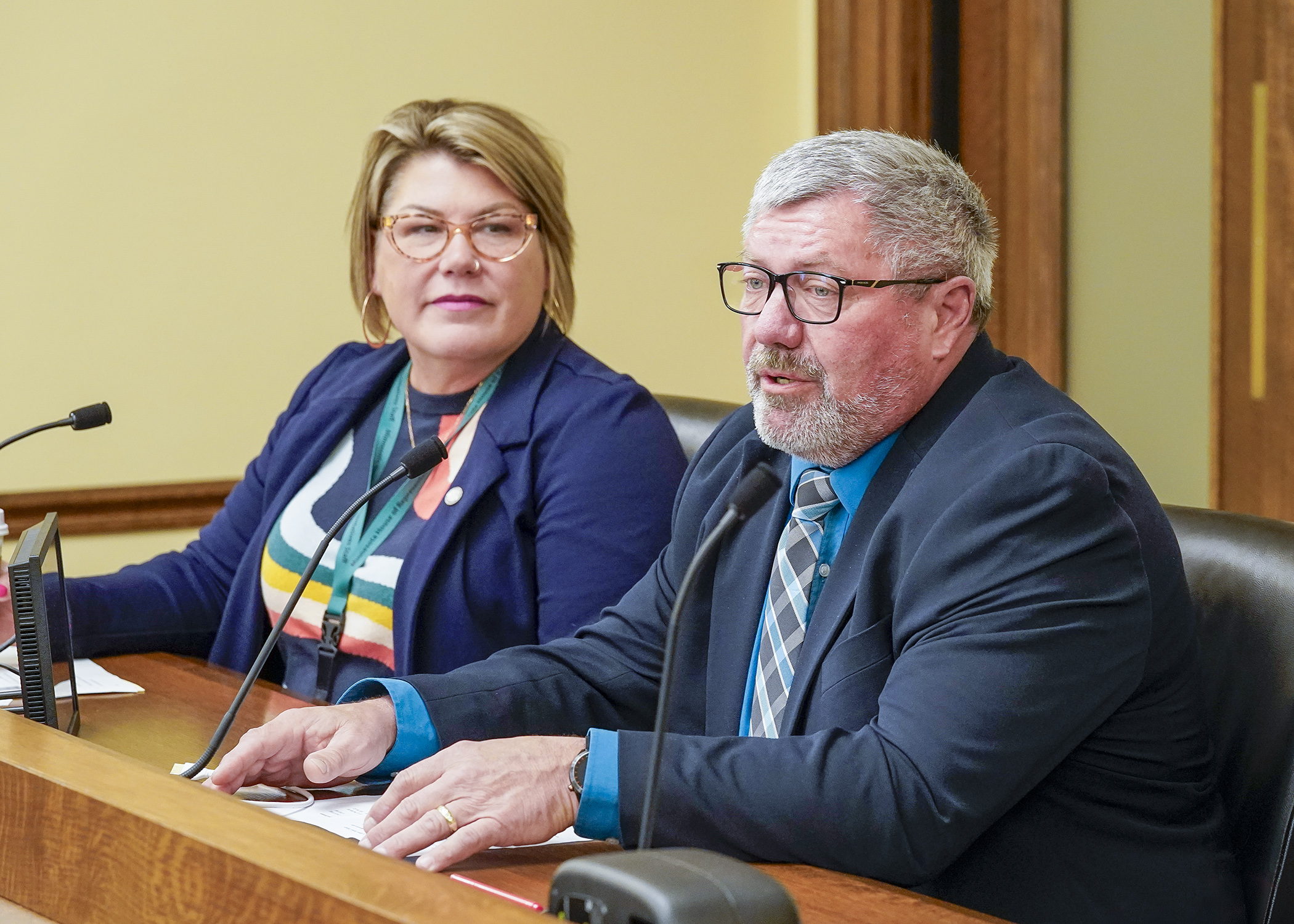
That’s why he came to St. Paul to testify in favor of HF3296, a bill sponsored by Rep. Dawn Gillman (R-Dassel) that would allow utility sales of electricity to certain data centers to be excluded from the state’s definition of “gross annual retail energy sales,” and, thus, not required to meet the ECO plan’s annual energy savings goal of 1.5% for a cooperative or municipal utility.
On Thursday, the House Energy Finance and Policy Committee approved a delete-all amendment and laid the bill over for possible omnibus bill inclusion.
“The bill merely keeps utilities from being penalized for not being able to meet an unattainable goal,” Gillman said. “If Minnesota wants to remain a leader in technology such as AI, passing House File 3296 is critically important.”
Rep. Larry Kraft (DFL-St. Louis Park) expressed skepticism about the idea that large data centers can’t find increased efficiencies in their energy use, saying that improved technologies will likely lead to less use of electricity.
When Rep. Chris Swedzinski (R-Ghent) asked Meyer if he’d seen the potential for more efficient use of electricity in the data mining facility in his service area, he said that he hadn’t.
“They’re built as efficiently as possible,” he said.
Related Articles
Search Session Daily
Advanced Search OptionsPriority Dailies
Could 2026 retirements lead to record turnover in the House?
By Lisa Kaczke In the final weeks of the legislative session, House members not seeking re-election to the body have taken a turn at gaveling in a floor session.
It’s an opportunity to loo...
In the final weeks of the legislative session, House members not seeking re-election to the body have taken a turn at gaveling in a floor session.
It’s an opportunity to loo...
How short are the Legislature's short sessions?
By Lisa Kaczke Rep. Ron Kresha (R-Little Falls) was ready to end the session March 25, making the motion to adjourn sine die. But not enough of his colleagues shared that sentiment, defeating ...
