 Dear Neighbor, Week three of the 2026 legislative session is underway at the Capitol, and new updates on Minnesota’s economy and our ongoing anti-fraud efforts are making headlines. Here’s the latest from St. Paul: State economic forecast State officials released an updated economic forecast on Friday. The key takeaway is that this new fiscal data gives us an opportunity to pass a bipartisan tax conformity bill that delivers real relief for workers through common-sense policies such as eliminating taxes on tips and overtime. Raising taxes on Minnesota families or expanding government spending should be off the table. Our priority must be making Minnesota more affordable by lowering costs, easing pressure on family budgets, and allowing hardworking Minnesotans to keep more of what they earn. Overall, Minnesota’s near-term budget outlook has improved despite ongoing economic uncertainty. The projected FY 2026–27 balance is now $3.7 billion, which is $1.3 billion higher than the November estimate. However, spending growth continues to outpace revenue growth through FY 2029. The previous trifecta made things worse when it spent the $18 billion surplus, raised taxes by $10 billion, and increased state spending by 40 percent. The projected general fund balance for FY 2028–29 is now $377 million, but a significant structural imbalance remains. The state is projected to spend $68.3 billion in FY 2026–27 while taking in $67.5 billion (a $2.9 billion gap). In FY 2028–29, spending is projected at $72.3 billion compared to $70 billion in revenue (a $2.3 billion shortfall). Shifting federal policies, volatile revenue sources, and incomplete data due to recent federal shutdown disruptions add further uncertainty to these projections. It’s also important to note that this is not a budget year in St. Paul. The state is fully funded for the remainder of the biennium under legislation passed last year. Our focus should be on passing a bipartisan tax conformity bill that aligns state and federal policies to provide relief for workers and support Main Street businesses who keep Minnesota strong. Tax hikes and additional government spending should remain off the table. The forecast again shows revenues coming in higher than expected, underscoring that Minnesotans are overtaxed. While progress was made last year, the structural imbalance remains and we still have a spending problem to address. If Minnesota wants to fully participate in the national economic rebound, we must change the policies that are holding back growth. Friday’s forecast also shows that even basic fraud prevention measures are reducing health and human services costs, a clear indication of how widespread and costly the problem has been. Fraud With a strong House Republican plan to crack down on fraud, we have a path to significantly reduce waste and abuse. For instance, House Republicans continue advancing legislation to create an independent Office of the Inspector General with real law-enforcement authority to combat fraud in Minnesota. Two weeks ago, House Democrats attempted to strip the bill of its enforcement powers and blocked a floor vote on the original version that passed the Senate 60–7 last spring. Last week, they again refused to advance the bill in committee because Republicans insist on preserving the office’s independence and authority. A credible Office of the Inspector General must be fully independent of the governor’s office. Unfortunately, efforts to weaken and delay this legislation continue. Fraud isn’t Free Act House Republicans also are addressing Minnesota’s fraud problem by introducing the Fraud Isn’t Free Act (H.F. 3395), a bill designed to add real consequences for state agencies that fail to prevent or address fraud. Minnesotans are counting on Republicans to protect their tax dollars and safeguard programs that vulnerable residents depend on. Republicans are working tirelessly to stop fraud and restore trust and accountability in state government. The bill requires agencies to submit a corrective action plan to legislative oversight committees whenever evidence of fraud is discovered. Agencies must also suspend enrollment in the fraudulent program and remove leadership responsible for the program, with dismissed employees barred from state employment for five years. The bill also requires Minnesota Management and Budget to estimate the cost of fraud in their budget forecasts and repeals the July 1, 2027 sunset on the state’s authority to withhold payments due to suspected fraud. Redactions on fraud report 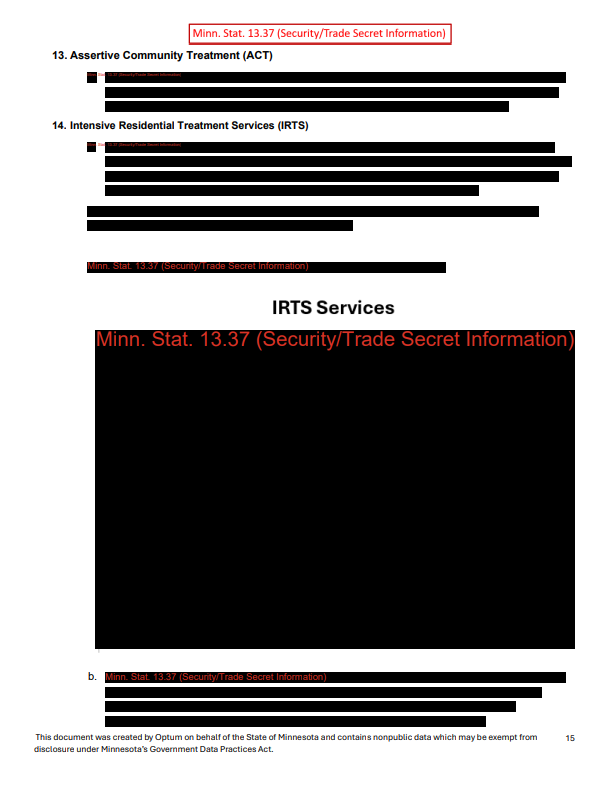 In my last newsletter, I mentioned the state’s recently released report on fraud risks in social services programs was heavily redacted. House Republicans have introduced a bill (H.F. 3378) requiring the release of the full content. The bill received a preliminary hearing, was approved, and now moves to its next committee stop. Minnesota taxpayers spent $2.3 million on this review for the Department of Human Services. They deserve transparency, not pages of blacked-out text. Access to the full report is essential to identify weaknesses in oversight and billing systems so we can make improvements and prevent future fraud. |