 Minnesota Legislature
State taxes on tips and some overtime pay would be eliminated under laid-over bill
If you were paid for working overtime or received tip income during 2025, you may have noticed something if you recently filed your federal tax return: Your tax bill for those earnings has shrunk.
Two provisions in the voluminous federal law known as the “One Big Beautiful Bill Act” signed last summer established temporary deductions for a portion of qualified overtime compensation and for qualified tips. But there’s a catch: You must add that income back into your reported earnings when filing your Minnesota tax return.
HF3524 and HF3525 would harmonize that issue. Sponsored by Rep. Kristin Robbins (R-Maple Grove), the bills would create a state subtraction that matches the federal deduction for qualified overtime pay and create another subtraction for tip income.
The House Taxes Committee laid over both bills Tuesday for possible omnibus bill inclusion.
“We have so many workers working so hard, and we want to encourage them to stay in the workforce here in Minnesota,” Robbins said. “If we have this federal conformity, it will allow them to file their taxes more easily. And it lets them keep more of their hard-earned money.”
So what’s “qualified overtime compensation?”
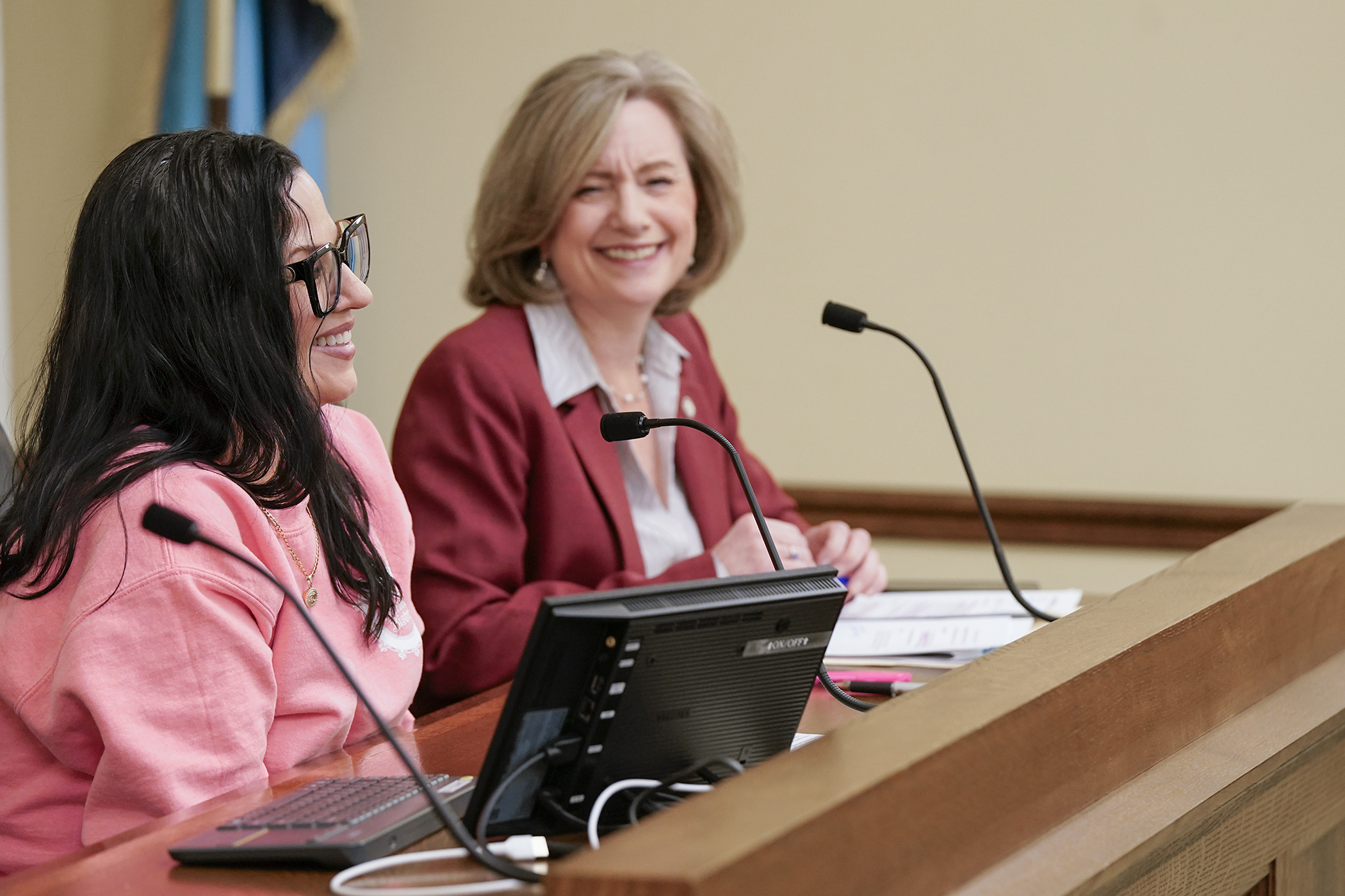 Sandra Weise, left, owner of the Finnish Bistro, shares a light moment with Rep. Kristin Robbins while testifying before the House Taxes Committee March 3 in support of a bill to establish a subtraction for tip income. (Photo by Michele Jokinen)
Well, a typical rate of pay for overtime is “time and a half,” or increasing hourly wages by 50% per hour. The federal deduction — and, if it passes, the matching state subtraction — would allow a worker to deduct that extra 50% per hour from their taxable income.
Similarly, HF3525 would make a worker’s tips non-taxable income on their state tax return, just as it currently is on their federal return.
The federal deduction for each provision is limited to $25,000 for married joint filers, or, in the case of the overtime provision, $12,500 for other filing statuses. For married filing joint returns, the deductions are each phased out beginning at $300,000, with the phaseout complete at $550,000.
For taxpayers with other filing statuses, the deduction is phased out beginning at $150,000 and is fully phased out at $275,000 for the overtime provision, $400,000 for the tips provision. The federal deduction expires after tax year 2028, but the state deduction would continue under the two bills.
The Revenue Department estimates the bills would reduce the state’s General Fund in Fiscal Year 2027, by $365.9 million and $126 million respectively.
And that was the primary sticking point for most testifiers, as well as several DFL members.
Nan Madden, director of the Minnesota Council of Nonprofits’ Minnesota Budget Project, contended that only 3% of U.S. workers would benefit from there being no tax on tips, while 9% would be aided by the overtime provision.
Rep. Andy Smith (DFL-Rochester) posited that the $491.9 million cost to the General Fund would be better directed toward the child tax credit, while Rep. Liz Lee (DFL-St. Paul) suggested that an increase in the working family tax credit would help more of the workers that Robbins’ legislation is intended to target. Rep. Liish Kozlowski (DFL-Duluth) said that an increase in the minimum wage would be far more beneficial for more of the state’s workers.
But Rep. Drew Roach (R-Farmington) supports the two bills.
“People are working overtime because the state is taxing them into oblivion,” he said. “Put money back in their pockets and do something for these people.”
Related Articles
Search Session Daily
Advanced Search OptionsPriority Dailies
Could 2026 retirements lead to record turnover in the House?
By Lisa Kaczke In the final weeks of the legislative session, House members not seeking re-election to the body have taken a turn at gaveling in a floor session.
It’s an opportunity to loo...
In the final weeks of the legislative session, House members not seeking re-election to the body have taken a turn at gaveling in a floor session.
It’s an opportunity to loo...
How short are the Legislature's short sessions?
By Lisa Kaczke Rep. Ron Kresha (R-Little Falls) was ready to end the session March 25, making the motion to adjourn sine die. But not enough of his colleagues shared that sentiment, defeating ...
