 Minnesota Legislature
Courts ask for $4.8 million to fund extra security, employer paid leave obligations
When thinking about hazardous jobs, being a cop might come to mind right away.
But being a judge is becoming increasingly hazardous with personal threats rising at an alarming rate.
That’s the message State Court Administrator Jeff Shorba brought to the House Judiciary Finance and Civil Law Committee Thursday.
A 2024 Minnesota District Judges Association survey showed 98% of judges say they have taken steps — such as limiting public personal information or safeguarding their homes — to increase personal safety because of their work.
Almost 90% of responding judges have received inappropriate communications because of their work, Shorba said, and 72% have received threats.
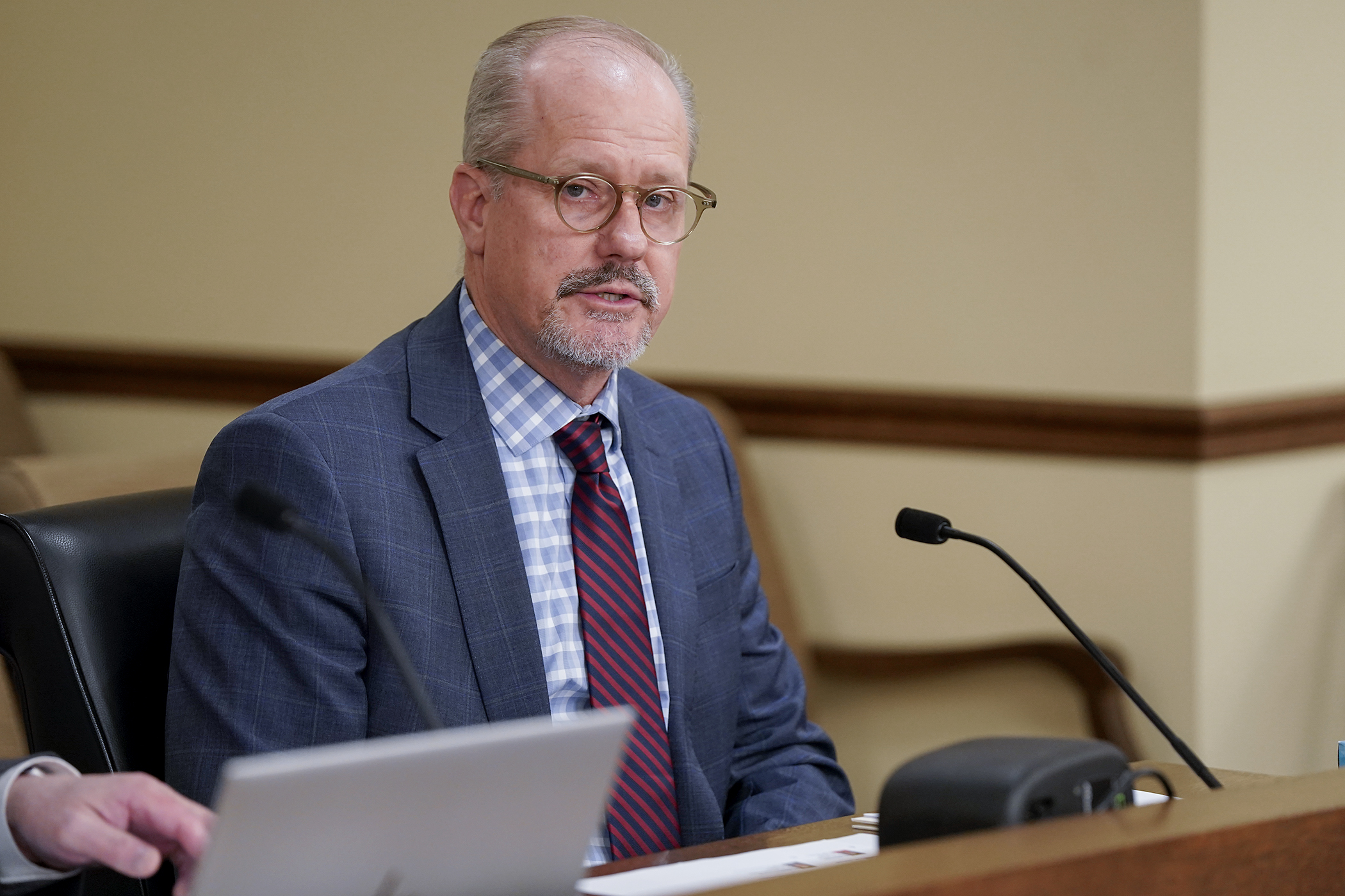 Michael Fritz, chief judge of the Seventh Judicial District, testifies March 5 before the House Judiciary Finance and Civil Law Committee in support of a supplemental funding bill for the state’s judicial branch. (Photo by Michele Jokinen)
He spoke in support of HF3874, sponsored by Committee Co-Chair Rep. Tina Liebling (DFL-Rochester), a supplemental budget request of $4.8 million from the General Fund in the current biennium.
The committee laid the bill over for consideration in a supplemental budget bill.
[MORE: View the supplemental budget request]
In his presentation, Shorba detailed how $2.9 million would be spent to help keep judges and other judiciary staff safe, and why the judiciary needs another $1.9 million to cover employer costs of the new Minnesota paid leave program.
Judges will tell you that they feel relatively safe in their workspaces because of physical security measures there, Shorba said, but the threats they face can take place anywhere and anytime.
“We are seeing more and more threats directed at judges’ residences and unfortunately judges’ families,” Shorba said.
For that reason, a portion of requested funds would go toward $1,000 grants for judges and other judiciary staff to install a home security system and reimbursement of up to $100 per month for monitored home security services.
Keeping the chief justice of the state Supreme Court safe is also addressed in the bill.
The Minnesota State Patrol would provide security and protection to the chief justice and give them the same powers and duties to enforce laws as sheriffs and other peace officers.
Money to fund the Minnesota paid leave program
The bill would appropriate $1.9 million to fund the employer portion of the Minnesota paid leave program.
Launched Jan. 1, the program provides job-protected leave and partial wage replacement for most workers in the state. It’s funded by payroll premiums that are typically shared between employers and employees.
Shorba explained in the state budget passed last year, all other branches of government received operating adjustments to pay the employer costs of the program. As a result, the courts have had to leave some vacant job positions unfilled to have the funds to pay into the paid leave program.
The judiciary is asking for “a little bit of fairness,” he said.
Liebling said the judiciary not receiving any operating adjustments for the paid leave program was an unintentional oversight.
Next steps
In 2025, the Legislature set a $1.42 billion budget in the 2026-27 biennium to fund the state’s judicial system: courts, civil legal services, Guardian ad Litem Board, Tax Court, Uniform Laws Commission, Board on Judicial Standards, Board of Public Defense, and Human Rights Department.
[MORE: 2026-27 budget spreadsheet]
Whether the requested $4.8 million will be fully funded is unknown; that is the task of the committee moving forward.
Because the 2026-27 biennium budget surplus is now projected to be $3.7 billion, up to that amount could be available for the Legislature to spend on supplemental budget requests.
But after the new budget forecast numbers were announced last Friday, Gov. Tim Walz said he would propose only a “modest” budget increase, with relatively little new spending.
Related Articles
Search Session Daily
Advanced Search OptionsPriority Dailies
Could 2026 retirements lead to record turnover in the House?
By Lisa Kaczke In the final weeks of the legislative session, House members not seeking re-election to the body have taken a turn at gaveling in a floor session.
It’s an opportunity to loo...
In the final weeks of the legislative session, House members not seeking re-election to the body have taken a turn at gaveling in a floor session.
It’s an opportunity to loo...
How short are the Legislature's short sessions?
By Lisa Kaczke Rep. Ron Kresha (R-Little Falls) was ready to end the session March 25, making the motion to adjourn sine die. But not enough of his colleagues shared that sentiment, defeating ...
