 Minnesota Legislature
Digital ads would be tax-free no more under bill
Once upon a time, the main place you’d find advertising was in a newspaper. But then billboards became ubiquitous, followed by commercials on radio, then television. Today, it’s an inescapable element of your online experience.
But did you know that no taxes are collected when digital ads are bought in Minnesota? Nor are they for billboards. Sponsored by Rep. Liz Lee (DFL-St. Paul), HF4343 would end the state’s tax exemption for digital advertising, sales and services, and do the same for billboards. And it would lower the state’s sales tax rate by 0.125%.
On Wednesday, the House Taxes Committee laid the bill over, as amended, for possible omnibus bill inclusion.
“We have transitioned from a goods-producing economy to a service-based economy,” Lee said. “Since the 1950s, the services sector has expanded from about one-half percent of [gross domestic product] to more than 75% of it. This trend matters because Minnesota taxes the majority of goods while exempting the majority of services.
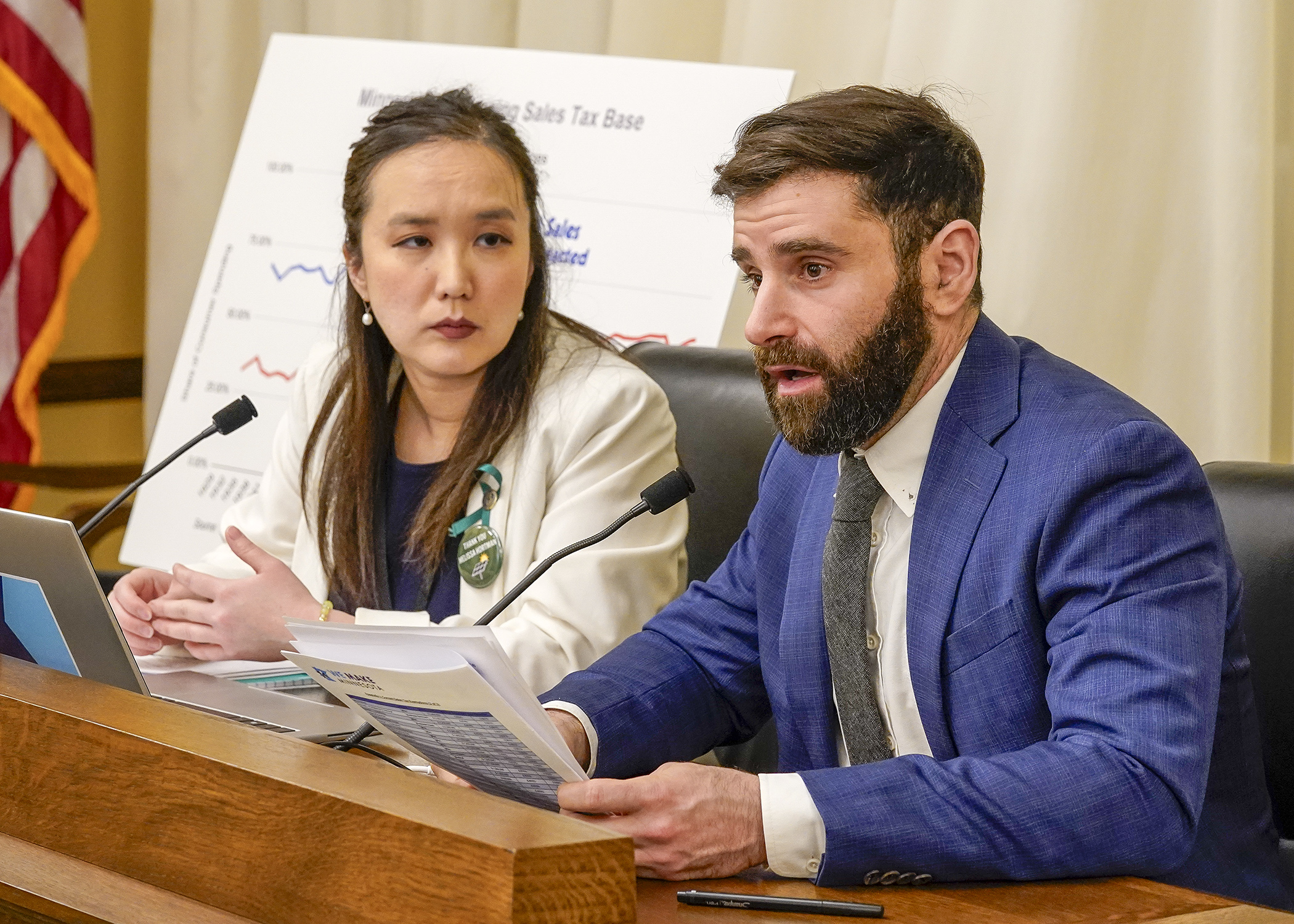 Eric Harris Bernstein, coalitions director for We Make Minnesota, testifies before the House Taxes Committee March 25 on a bill sponsored by Rep. Liz Lee, left, that would impose an advertising service tax. (Photo by Andrew VonBank)
“By exempting advertising services from sales tax, we are giving taxpayer dollars to the platforms seeking our attention on social media, internet search results and websites, which seem to be packing more and more banner ads each day, each week, trying to grab our attention.”
The bill would impose sales tax on certain advertising services for both digital and nondigital advertisements. The tax would also be imposed on services ancillary to producing the advertisements. And it would reduce the state sales tax rate from 6.5% to 6.375%, effective for sales and purchases made after Sept. 30, 2026.
The Revenue Department estimates that the bill’s changes in the tax code would increase state revenues by $92.2 million in Fiscal Year 2027 and $340.3 million in the next biennium.
But Rep. Mike Wiener (R-Long Prairie) characterized the bill as a tax on consumers, saying that the advertisers were merely going to pass the extra costs on. And Rep. Wayne Johnson (R-Cottage Grove) argued that Minnesota has become a harder place to start a small business and that barriers to internet advertising would make it more so.
Rep. Andy Smith (DFL-Rochester) countered that the lower overall sales tax rate would help businesses by lowering the costs of their purchases. And Rep. John Huot (DFL-Rosemount) said he sees the bill as a means toward slowing the rapid expansion of the internet’s place in the state’s economy.
But the committee’s co-chair, Rep. Greg Davids (R-Preston), gave little hope to the proposed changes making the committee’s final product.
“This is never going to work,” he said. “Sales taxes are very regressive. … I’m not here to raise taxes on the poor, and this would do that.”
But Lee underlined her point that the state is paying for not updating its sales tax system.
“We’re at a pretty critical juncture,” she said.
Related Articles
Search Session Daily
Advanced Search OptionsPriority Dailies
Could 2026 retirements lead to record turnover in the House?
By Lisa Kaczke In the final weeks of the legislative session, House members not seeking re-election to the body have taken a turn at gaveling in a floor session.
It’s an opportunity to loo...
In the final weeks of the legislative session, House members not seeking re-election to the body have taken a turn at gaveling in a floor session.
It’s an opportunity to loo...
How short are the Legislature's short sessions?
By Lisa Kaczke Rep. Ron Kresha (R-Little Falls) was ready to end the session March 25, making the motion to adjourn sine die. But not enough of his colleagues shared that sentiment, defeating ...
