 Minnesota Legislature
Public safety, judiciary finance conferees begin work to close big budget gap
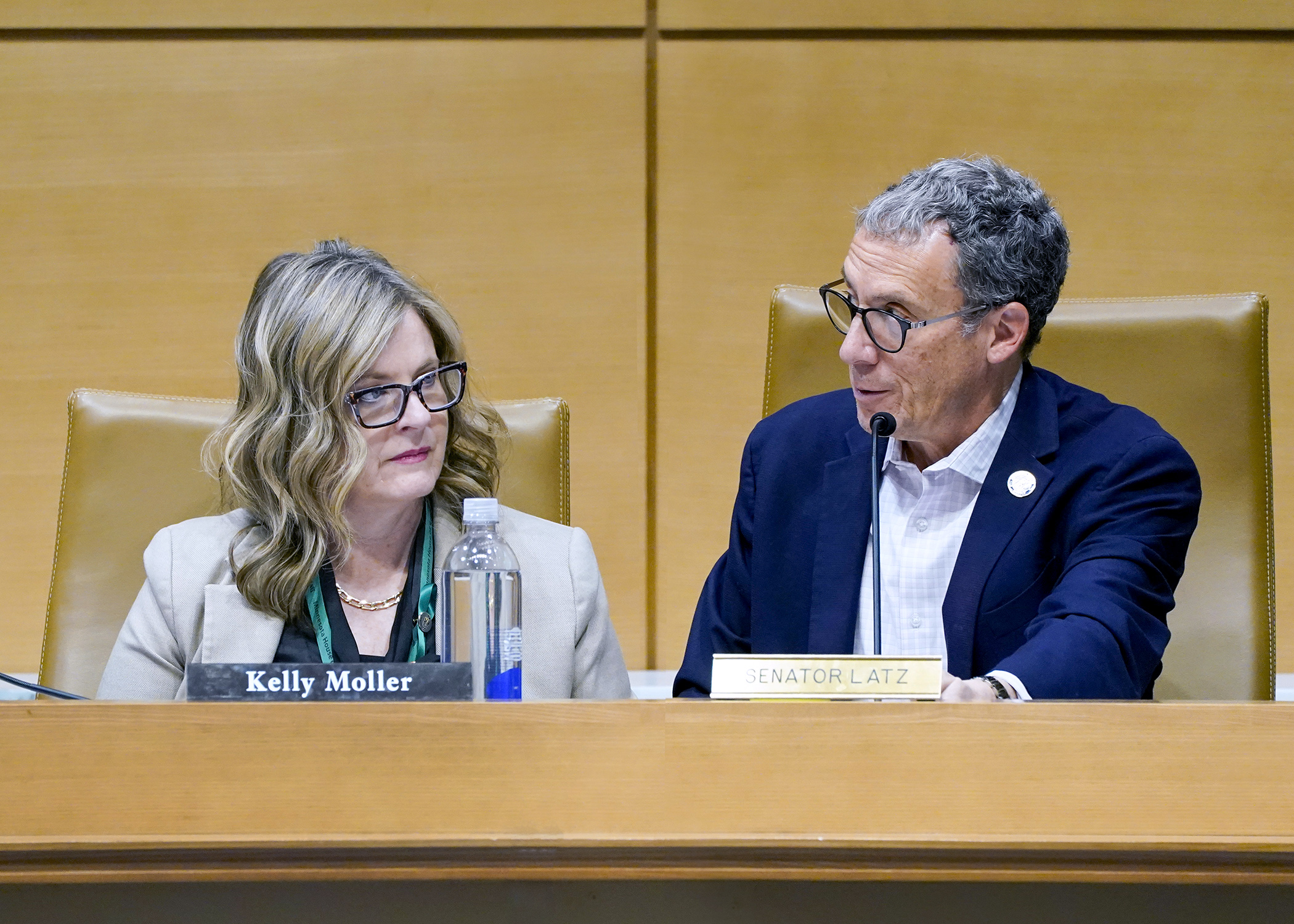
The public safety and judiciary finance package conference committee has a big task ahead: closing a $23 million gap between House and Senate supplemental budget proposals.
Wednesday morning conferees heard nonpartisan Senate staff walk through the side-by-side fiscal spreadsheet and bill language, took testimony, and considered but did not act upon an amendment offered by Rep. Kelly Moller (DFL-Shoreview).
Complicating, or at least delaying, a resolution is the conference committee has not received a spending target from legislative leadership.
Sen. Ron Latz (DFL-St. Louis Park) said the meeting would resume when the committee has action items to consider — i.e., voting on what provisions to include in a final report.
Moller and Latz sponsor HF3230/SF3432*, and each said they have the same public safety goals in mind, as demonstrated by both chambers proposing almost equivalent provisions, some with exact wording, many with very similar wording, and only a few provisions present in one side’s bill and not in the other.
[MORE: House passes bill to boost spending on security at State Capitol, Minnesota courtrooms]
The bottom lines
However, the money differences are big, with the Senate’s price tag for new 2026-27 biennium funding at $47.32 million and the House $24.17 million.
Much of the $23 million gap resides in proposed Department of Public Safety spending. The House would spend $15.13 million and the Senate $38 million. Among the differences (House numbers first):
- $6.68 million/$12.16 million for Capitol security screening;
- $4.45 million/$10.83 million for Capitol security enhancements; and
- $960,000/$12.08 million for legislative services/protective services unit.
These amounts would provide enhanced security services from the State Patrol to legislators in the Capitol area and beyond if necessary, and retain extra Capitol security personnel and screening stations at building entrances that were installed before the first day of the 2026 session.
Both versions would appropriate $1.01 million to fund the Bureau of Criminal Apprehension’s threat assessment unit, which assesses and investigates concerning behaviors in individuals and groups to identify threats and prevent targeted violence.
“Capitol security is not just about the Capitol, it’s a commitment to making legislators, staff, and the public safe so that this can be a place where everyone who visits has an opportunity to participate and have their voices heard,” Public Safety Commissioner Bob Jacobson said.
Judges and other judicial staff are also facing increasing threats of violence, said Second District Judge Richard Kyle. He is also president of the Minnesota District Judges Association.
Approximately 140 security incidents have been reported to the Judicial Branch in the first quarter of 2026, he said, a 100% increase from the same period in 2025. And a 2024 survey showed more than 70% of judges have changed their personal behavior in response to increased security threats.
In judiciary spending, the House would make a one-time Fiscal Year 2027 appropriation of $4 million — the Senate $1 million — to fund a competitive grant program to boost courthouse security assessments, equipment, technology, construction, or training needs.
Judges and judicial staff would also get money — $1.28 million (House) or $1.36 million (Senate) to buy home security systems and pay for monthly monitoring.
Related Articles
Search Session Daily
Advanced Search OptionsPriority Dailies
Could 2026 retirements lead to record turnover in the House?
By Lisa Kaczke In the final weeks of the legislative session, House members not seeking re-election to the body have taken a turn at gaveling in a floor session.
It’s an opportunity to loo...
In the final weeks of the legislative session, House members not seeking re-election to the body have taken a turn at gaveling in a floor session.
It’s an opportunity to loo...
How short are the Legislature's short sessions?
By Lisa Kaczke Rep. Ron Kresha (R-Little Falls) was ready to end the session March 25, making the motion to adjourn sine die. But not enough of his colleagues shared that sentiment, defeating ...
