Fraud Monitor: April & May in Review Welcome back to the MN Fraud Monitor.April and May closed a two-year legislative cycle in which Minnesota’s fraud crisis moved from isolated program failures to a statewide oversight issue and a major federal enforcement priority. The Legislature adjourned sine die on May 18th. Before adjournment, lawmakers passed several fraud-related measures, the House Fraud Committee approved its final report, and federal investigators continued work across child nutrition, Medicaid, autism services, housing stabilization, home supports, and childcare. Good intentions have not been enough to ensure that programs meant to help the most vulnerable are operated with integrity. That requires serious competence, engagement, and accountability across the state: from agencies tasked with administration, to providers and individuals giving and receiving services, to Minnesotans demanding that government at every level operate with transparency and integrity. Session Fraud Legislation: What Passed and What Moved Statewide Office of Inspector General Lawmakers established a new independent Office of Inspector General in the executive branch. The proposal cleared the Senate with broad support in 2025 but stalled in the House before returning this session. In 2026, the House passed the final bill 127-5, the Senate concurred 66-0, and Governor Walz signed it into law in May. The Inspector General will be appointed by the governor to a five-year term and confirmed by a three-fifths vote of the Senate. (1) (2) (3) (26) The office is scheduled to be fully operational by September 1, 2027. Its responsibilities include overseeing agency inspectors general, investigating credible allegations of fraud or misuse in state programs, establishing best practices, facilitating cross-agency information sharing, and issuing public reports after completed investigations. Beginning January 1, 2028, the office may establish the Inspector General Anti-Fraud and Waste Bureau. (1) (2) Expanded Payment-Withholding Authority HF3629 removes the prior 60-day limit on withholding payments, eliminates the 2027 expiration date, and lowers the standard to a credible allegation of fraud verified by the agency. It also allows agencies to share information about suspected participants receiving payments from multiple state agencies, provided doing so does not compromise an active investigation. (4) (5) The bill requires DHS and DCYF to submit annual program-integrity reports. DHS’s first report is due November 30, 2026. DCYF’s first report is due January 1, 2027. (4) (5) Additional Human Services Provisions The House human services policy bill included prepayment review for Medical Assistance claims and claims in 14 high-risk DHS programs, enrollment moratoriums of up to two years for those high-risk programs, 90-day payment-withholding authority for Medical Assistance, formal termination of Housing Stabilization Services, and legislative access to the unredacted Optum report. (6) Medicaid Fraud Bill The House passed HF2354 by a vote of 118-16. As passed by the House, the bill would provide $1.23 million annually from fiscal years 2027 through 2029 for 18 new positions in the Attorney General’s Medicaid Fraud Unit: 11 investigators, three attorneys, and four support staff. (7) (8) The bill would also expand the definition of Medicaid fraud to include conduct such as lying during provider enrollment, falsifying service records, and destroying records requested by a state agency. It would create stronger penalties for Medicaid fraud over $100,000 and over $1 million. (7) (8) Other Key Measures Human services IT modernization legislation created the Human Services IT Systems Modernization Fund, effective July 1, 2026. The law includes funding for fraud prevention and detection technology, DHS and DCYF modernization work, MNIT, and county health and human services systems. (9) The fund is a vehicle for modernization, not a complete fix. Minnesota still has significant work ahead to move beyond outdated technology, resolve data-sharing barriers, and use modern tools effectively across agencies and programs. The higher education bill included $3 million in fiscal year 2027 for Minnesota State to purchase software to detect and prevent ghost-student fraud. It also strengthened the Office of Higher Education’s ability to deny grants to applicants who provide false or misleading information, refuse reasonable requests for information, or have been found to have committed fraud or major violations involving government funds. (10) Grant oversight provisions require the Office of Grants Management to implement a fraud risk rating system for state grantees, effective February 1, 2028. The language came from grant-management legislation and was later included in the state government package. (11) (12) Dates and Implementation Items to Watch - July 1, 2026: Human Services IT Systems Modernization Fund effective. (9)
- November 30, 2026: DHS first annual program-integrity report due. (4) (5)
- January 1, 2027: DCYF first annual program-integrity report due. (4) (5)
- September 1, 2027: Statewide Office of Inspector General fully operational. (1) (2)
- February 1, 2028: Office of Inspector General’s first annual report due. (1) (2)
- February 1, 2028: Grant fraud risk rating system effective. (12)
Executive Branch Program-Integrity ActionsThe executive branch has also taken direct action through fraud-focused executive orders and DHS program-integrity efforts. Executive Order 25-10 directed state agencies to continue combatting fraud across Minnesota government programs, and Governor Walz later ordered a third-party audit and payment pause for 14 high-risk Medicaid services. (20) (21) DHS has implemented prepayment review for certain Medicaid benefits and services and has advanced provider revalidation through Minnesota Revalidate 2026. These steps reflect a stronger front-end posture that was long needed. (22) (23) Implementation has also raised serious concerns. Media reports highlighted suspended payments, delayed payroll for providers, and disruptions affecting care for older and disabled Minnesotans. As of late May, thousands of providers remained in limbo during revalidation. (27) (28) (29) (30) The state’s stronger fraud posture is necessary, but intention is not enough. Results will depend on whether agency leadership can stop fraud without creating new administrative failures that harm legitimate providers and vulnerable residents. That will be a central test for state leadership going forward. 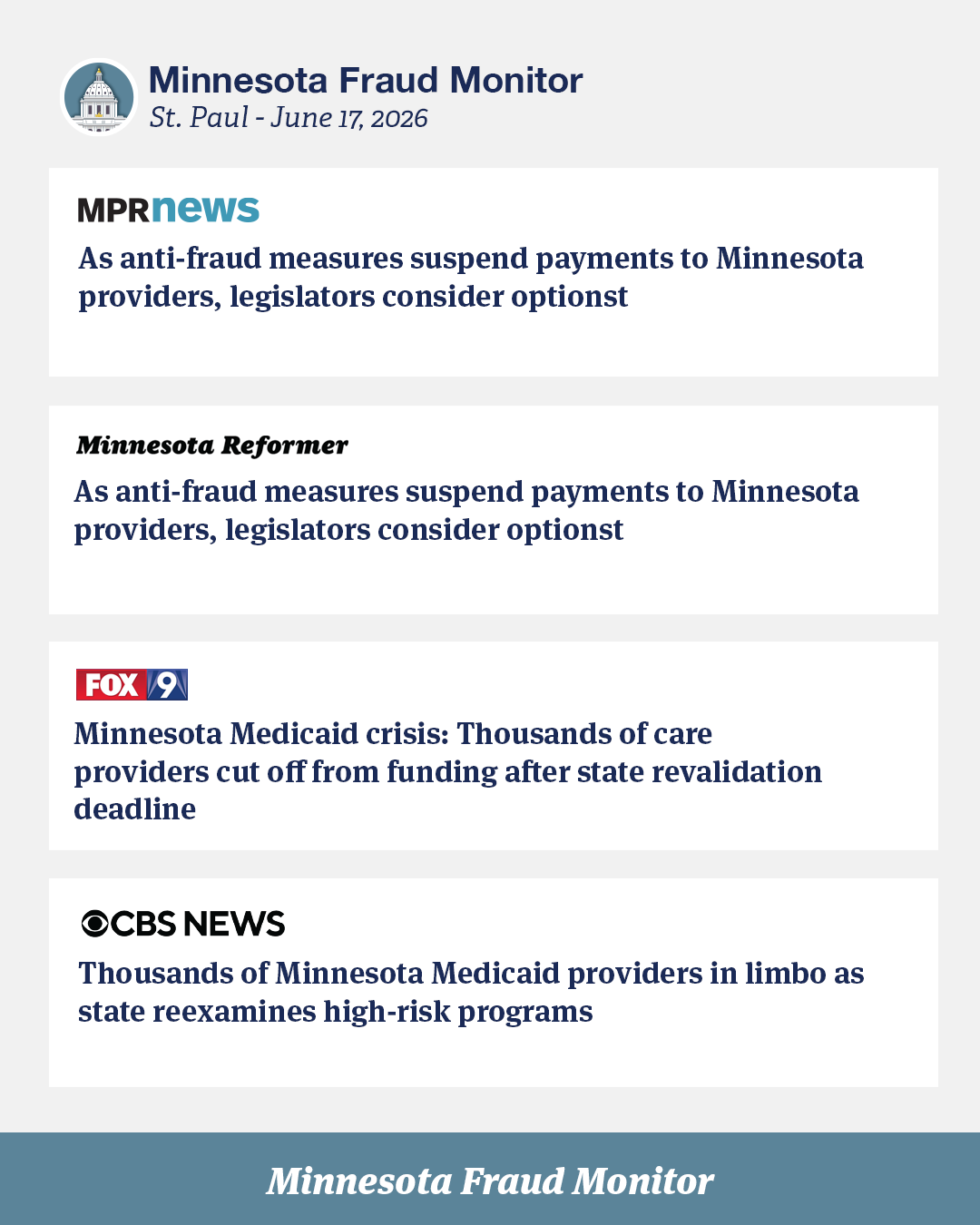 House Fraud Committee Final ReportThe House Fraud Prevention and State Agency Oversight Policy Committee approved its final report in May. The committee was established in January 2025 and held 25 meetings. The final report followed testimony, whistleblower submissions, agency records, and prior Office of the Legislative Auditor findings. (13) The 84-page report passed on a party-line vote, with Republican members supporting the report and DFL members abstaining. Recommendations included technology modernization, stronger provider documentation, in-person site visits before billing begins, improved attendance records in high-risk programs, and automatic stop-payment triggers when a program’s budget increases by at least 50 percent over the prior year. (13) On May 5, the committee considered a motion to subpoena records from U.S. Rep. Ilhan Omar related to Feeding Our Future and the federal MEALS Act. The motion failed 5-3 because House rules required six votes. The requested records involved communications related to Feeding Our Future and individuals or entities referenced in federal trial exhibits. (14) Feeding Our Future Case DevelopmentsAimee Bock, founder and executive director of Feeding Our Future, was sentenced to 500 months in prison in connection with a more than $250 million federal child-nutrition fraud scheme. According to DOJ, Feeding Our Future’s federal child-nutrition disbursements increased from about $3.4 million in 2019 to nearly $200 million in 2021. The scheme involved false meal counts, fake attendance rosters, and claims for meals not served. (15) Additional April developments included: - Abdullahe Nur Jesow was sentenced to 43 months in prison and ordered to pay $866,458 in restitution. Academy for Youth Excellence and S&S Catering received about $4.286 million while serving only a fraction of claimed meals. (16)
- Suleman Yusuf Mohamed and Gandi Yusuf Mohamed pleaded guilty, bringing total convictions to 65. Star Distribution received about $10.1 million for purportedly serving about 4.8 million meals while spending very little on actual food. Suleman Mohamed agreed to pay more than $8.66 million in restitution, and Gandi Mohamed admitted to laundering about $1.3 million through real estate transactions. (17)
|