Legislative Update This week, we officially hit the halfway mark as we work toward adjournment sine die on May 17th—but don’t expect things to slow down anytime soon. Affordability remains front and center as we head into the second half of session, and I’m proud to say we’ve made some strong progress this week. Let’s get into it! Accountability Is Back on the TableA few weeks back, I talked about House File 1338, which would create an independent Office of the Inspector General. Just as a quick recap: this legislation passed the Senate unanimously, 60-7. That’s about as bipartisan as it gets. But when it made its way to the House, it was quickly killed by the DFL. Minnesotans have watched major fraud schemes unfold for years, and somehow the idea of independent oversight became a controversial issue for reasons unbeknownst to many of us here at the legislature. Cleaning up fraud in our state shouldn’t depend on who’s in the Governor's office. That’s exactly why this bill is so crucial. It creates a fully independent Office of the Inspector General—completely nonpartisan and not under the thumb of any politician. No games, no excuses, just good old fashioned accountability. Now, here’s some good news The House State Government Committee recommended an OIG bill for passage Tuesday morning that closely mirrors the version already passed by the Senate with strong bipartisan support. House Democrats pushed to water down key provisions, but we held the line, because this bill is just too important to weaken. We brought this bill forward multiple times, and each time, we were met with resistance. But we didn’t back down. Eventually, I think it became clear: we were serious about preserving the bipartisan, bicameral work already done in the Senate—and we weren’t going to accept anything less. Funny how things start moving when you stop taking “no” for an answer. The bill now heads to the House Ways and Means Committee, and there’s real hope it could make it to the governor’s desk before the end of session. This is a step in the right direction, and I’ll keep pushing every day to make sure it gets across the finish line. Putting the Brakes on Rising Tab Fees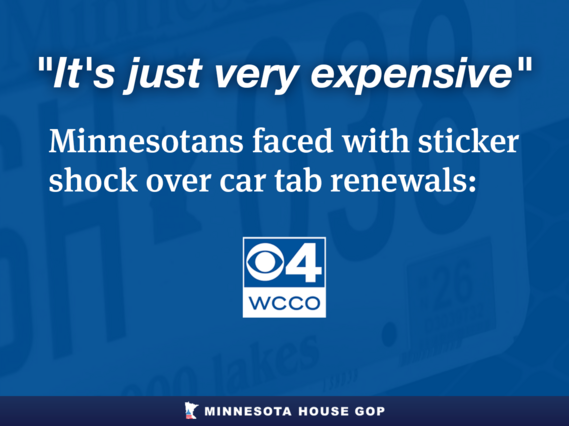 A few weeks ago, we heard a truly jaw-dropping comment from a first-term DFL legislator, suggesting that at some point she may offer an amendment to quintuple the price of car tab fees. Whether it was meant as a joke or not, I don’t think many Minnesotans found it funny at all. In fact, we’ve been hearing from constituents all across the state who are already frustrated with how much their tab fees have skyrocketed over the past year. In a story from WCCO this week, one Minnesotan stated: “We paid the tab on it for the first time and the next year it was more expensive. The car depreciates, but the tax goes up? Really? Is that how that’s supposed to work? I don’t think so.” He's exactly right. The reality is Minnesota is facing an affordability crisis—frankly, the entire country is. But it’s our job as legislators to make sure Minnesota remains a place where folks can raise their families, work, and most importantly afford to live here, and I wish Democrats would snap out of this delusion that raising taxes across the board is at all a logical solution. I’m grateful to my colleague Rep. Patti Anderson for taking those remarks seriously—and more importantly, for taking Minnesotans seriously. On Wednesday, she introduced legislation to bring tab fees back to pre-trifecta levels. During the Democrat trifecta, higher tab fees were included as part of over $10 billion in new taxes on Minnesota families. Changes to the formula increased fees by roughly 20%, leaving drivers paying more just to stay on the road. At the same time, Minnesota’s tab fees now far exceed those in neighboring states like Wisconsin and North Dakota, who have a flat rate fee of around $85. Rep. Anderson’s bill would reverse those increases and return rates to where they were—delivering nearly $1 billion in relief to Minnesota drivers. This is the real relief Minnesotans are calling on us legislators to deliver, I just hope my DFL colleagues will come to the realization sooner rather than later. More Money Back Where It Belongs, In Your Pocket This week in the Taxes Committee, we continued conversations around federal tax conformity—because at the end of the day, affordability matters, and Minnesotans are feeling the pressure. One of the proposals we heard would increase the amount you can exclude from your gross income for dependent care assistance—from $5,000 up to $7,500 if we align with federal law. That’s real relief for working families trying to balance the cost of childcare and everyday expenses. We also reviewed House File 4321 and House File 4322, which both focus on bringing Minnesota in line with recent federal changes. One expands the exclusion for dependent care assistance programs, and the other expands the dependent care tax credit. In simple terms, these bills are about making sure Minnesota families aren’t missing out on tax relief that’s already available at the federal level. Affordability comes down to two things: either government spends less, or Minnesotans pay less. Right now, families across our state are feeling squeezed from all sides—property taxes, inflation, rising everyday costs—and it’s clear we need to take a serious look at providing meaningful tax relief. That means being responsible with spending, ensuring strong oversight, and putting the right checks and balances in place so taxpayers know their dollars are being used wisely. These may seem like small changes—but they matter. And I’m hopeful we can get some of these commonsense solutions across the finish line before the end of session. Wrapping Up the Week on a Bright NoteAs always, please keep reaching out and sharing your thoughts, concerns, and ideas—I always appreciate hearing from you. I’ll keep pushing to bring some much-needed fiscal sanity back to St. Paul. Enjoy the warmer weather this weekend, we’ve earned it! Sincerely, —Representative Jim Joy |