Legislative Update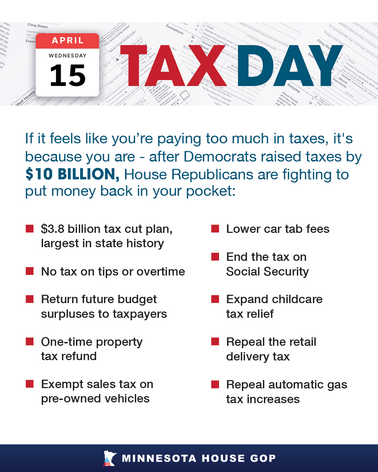 Dear neighbors, I’m going to skip the fluff this week and get straight to what’s on everyone’s mind. Tax Day was Wednesday, and if your experience looked anything like mine, it’s clear: Minnesotans are overtaxed, plain and simple. Down at the Capitol, things are moving fast. We passed our first and second legislative deadlines last week, and the final deadline for bills is today at 5:00 p.m. From here, committees wrap up, though the tax committee will keep working right up until the end of session on May 17. I want to be very clear about one thing: I hear you. The frustration, the questions, the “how is this sustainable?” conversations—you’re not shouting into the wind. House Republicans have proposals (see above) ready to go that would ease the burden, rein in costs, and bring some common sense back to how we tax Minnesotans. Now we just need the opportunity to get them across the finish line. I’ll keep fighting to make sure your voice is part of that conversation every step of the way. Don’t Let Costs Roll Downhill: Why Federal Alignment MattersYou’ve probably heard me bring this up a few times this session, but it’s worth breaking down because it’s one of those behind-the-scenes issues that has very real, very noticeable impacts on your wallet. Let’s start with “federal conformity.” Federal conformity means Minnesota aligns parts of our tax code with the federal government. When we don’t align, we risk losing out on federal dollars tied to those provisions. But the costs tied to those programs don’t just disappear. Instead, they get pushed down to counties… and eventually, to you. That’s the cost shift. Local governments are left to make up the difference, and more often than not, that means higher property taxes and increased costs across the board. That’s why we are working to align with the federal tax code—not move away from it. This week, we worked to do exactly that by advancing House File 3127, which includes the pass-through entity (PTE) tax extension. This provision costs the state of Minnesota nothing—zero—but prevents hundreds of millions of dollars in new taxes from hitting Minnesota job creators. If we fail to act, small businesses across our state will be facing a massive and unnecessary tax increase. That makes it harder to grow, harder to hire, and harder to reinvest in the communities they serve. And when there’s uncertainty like this, businesses don’t just shrug it off—they pull back. Hiring slows. Expansion plans get put on hold. Some even start looking elsewhere for a more stable environment. We should be doing the opposite. House Republicans are focused on creating a business climate where employers can grow, hire, and compete—not just survive, but actually thrive. That starts with keeping taxes predictable and making it clear that Minnesota is open for business. Because when we get that right, it doesn’t just help businesses, it helps every community that depends on them. Who Decides the Tax Rate? Local Voices or Statewide Mandates?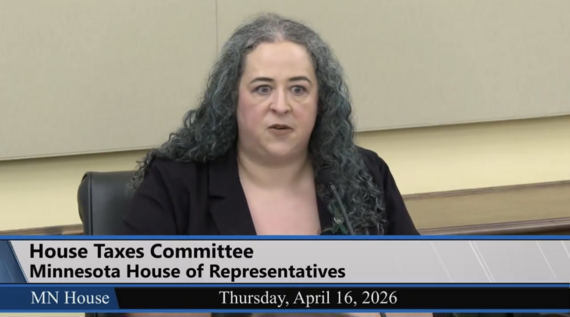 To tax or not to tax—that is the question. In the Tax Committee on Thursday, we heard a state tax policy that the Senate regularly considers and approves: allowing cities and counties to set what are called “local option sales taxes.” Our agenda included 11 requests from local governments, stretching across the state from Roseau to Owatonna. These proposals seek to increase local sales taxes by 0.25% to 0.5% to fund construction or improvements for government buildings, fire halls, jails, community centers, parks, sports facilities, and other local infrastructure. At its best, this is a band-aid on an open wound—but for many communities, it’s the only solution we've got. It is also one of the closest things we have to a “we the people” tax policy, because it ultimately goes through a local referendum. This is very important. If you click on the photo above, you will hear the Chair of the Tax Committee, Rep. Aisha Gomez (D–Minneapolis), suggest that if cities want these improvements in their communities, then we need to implement, yet again, another statewide to achieve it. At a time when Minnesotans are feeling completely overwhelmed by rising costs, we cannot continue layering on additional burdens without serious consideration of the impact. I really hope Rep. Gomez will reconsider her resistance to including measures like this in the final tax bill and recognize the importance of local control. I hear from many constituents who want to be the ones with the say—and this gives them exactly that option. On the other side of the aisle, there is clear resistance to this approach, with a preference for decisions made at the state level. But I believe these choices are best made by the people, in their local communities. This ensures taxpayers who are already feeling the squeeze have a real voice at the ballot box. Let's Stay Connected!As always, I am so grateful for your continued support and I’m so grateful for the opportunity to represent you. As always, my door is open to you. Please feel free to stop by my office for a meeting or reach out via email at rep.jim.joy@house.mn.gov or by phone at 651.296.6829. I’m here to listen and work together for our community's success! Sincerely, —Representative Jim Joy |