 Minnesota Legislature
Employee calls for ‘massive change’ at Department of Human Services, including leadership
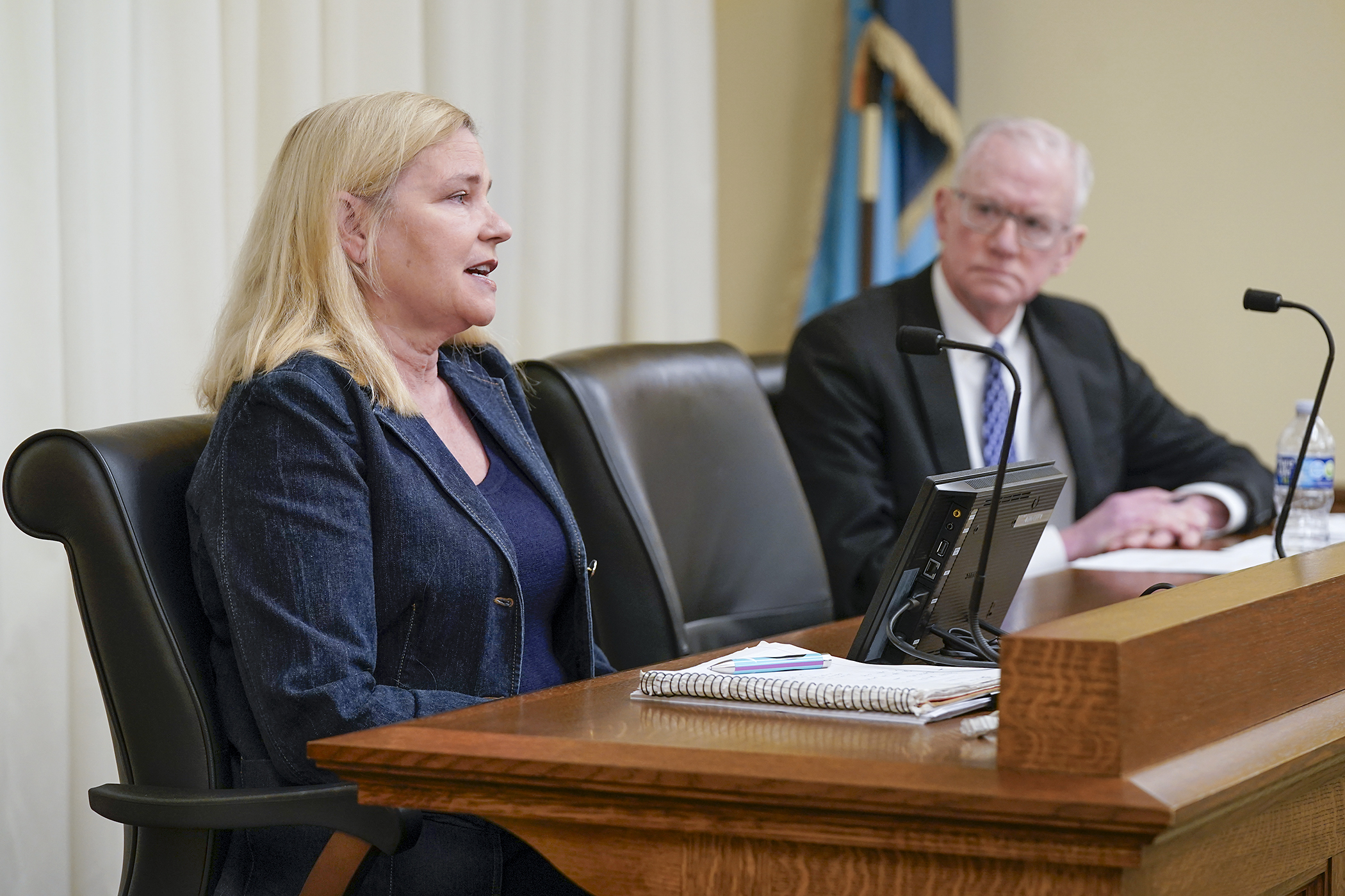
Faye Bernstein shared her story Monday and put forth a powerful, targeted declaration.
A 20-year employee at the Department of Human Services, Bernstein disparaged the department culture by telling what happened about seven years ago when she questioned its activities.
“In the course of doing my job I came across some contract irregularities that I would consider in the scope of what we talk about today to be quite minor. But as minor as they were it was not something DHS leadership could hear. As I result of me speaking about it, I was locked out of the building, I was banned from all DHS owned and licensed property,” she told the House Fraud Prevention and State Agency Oversight Committee.
A multiple-month investigation, including allegations of racism and threatening to harm leadership, Bernstein said the results showed, “I was found to have questioned the competency and the decision-making of the leadership in the Behavioral Health Division, and I was found to have held up contracts that had compliance problems. … I absolutely did both of those things and I’m doing both of those things today. I am very much questioning the competency of the leadership of the Department of Human Services.”
She knows those people well, but change needs to be made because the proper mindset and actions are absent.
“Compassion when huge amounts of money is stolen is not the right thing to do,” Bernstein continued. “… You think about people this winter had fingers and toes frozen off because the Department of Human Services had to shut down a program. People without homes had real consequences.”
Because of “large-scale fraud” found by its own Office of Inspector General, the department ceased operations of the housing stabilization services program Oct. 31, 2025.
Bernstein’s experience ties into a recent report by the state’s director of program integrity showing there has been almost 50 years of state awareness of vulnerabilities in public programs that has enabled decades of fraudulent activity, much of that targeted at the department in recent years.
“This year-after-year, decade-after-decade problem, I do not see how we can come through this without a massive change at the Department of Human Services in our leadership. There just really simply has to be firings. I hate to say that, I hate to see people fired, but there is no other way to turn this around. … The need to retaliate against people who speak up as I initially did in the most benign ways, the need to retaliate against people like me is so ingrained. It is through every step of the process.”
Rep. Kristin Robbins (R-Maple Grove), the committee chair, said Bernstein is speaking for hundreds of people at the department and others no longer working there. Officials were invited to appear at the hearing, but were absent. However, Commissioner Shireen Gandhi appeared in the same room minutes after the fraud committee hearing for the House Ways and Committee.
“Extraordinarily infuriating” is how Rep. Walter Hudson (R-Albertville) described Bernstein’s testimony, particularly taking aim at the racism allegations.
“One of the ways to judge the veracity of testimony is to compare it against other evidence. We have heard on tape Attorney General Keith Ellison meeting with people who would later be indicted and some convicted in the Feeding our Future scandal. And what was their entire premise of their complaints? That state agencies are being racist. He bought into that; he said (Gov. Tim) Walz feels the same way. That is consistent with what we’re hearing from Ms. Bernstein right now.
“The question becomes why retaliate? What possible motivation could you have, what innocent and benign explanation is there for the type of retaliation that she’s describing? I can’t think of any, but the culture seems to be very intentional. I’ll leave it at that.”
Roadmap to prevent fraud
Named the state’s director of program integrity on Dec. 12, 2025, Tim O’Malley is a judge and former FBI agent and former Bureau of Criminal Apprehension superintendent.
Tasked with strengthening fraud protection to saving taxpayer dollars, he wrote the Feb. 23 scathing report showing a lot of work is needed.
“Minnesota’s fraud vulnerabilities have existed for decades. Historical reports from state and federal auditors repeatedly identified internal control weaknesses, yet corrective actions were either not executed or inconsistently implemented. A “too trusting mindset” and a system biased toward facilitating payments — rather than safeguarding funds — contributed to creating opportunities for exploitation,” per the report.
Employee training and technology upgrades are among the “nine pillars of reform” called for by the report. “Modern criminal schemes require modern tools. Data sharing, use of analytics, monitoring tools such as GPS, biometrics, cameras must be leveraged,” O’Malley said.
Related Articles
Search Session Daily
Advanced Search OptionsPriority Dailies
Could 2026 retirements lead to record turnover in the House?
By Lisa Kaczke In the final weeks of the legislative session, House members not seeking re-election to the body have taken a turn at gaveling in a floor session.
It’s an opportunity to loo...
In the final weeks of the legislative session, House members not seeking re-election to the body have taken a turn at gaveling in a floor session.
It’s an opportunity to loo...
How short are the Legislature's short sessions?
By Lisa Kaczke Rep. Ron Kresha (R-Little Falls) was ready to end the session March 25, making the motion to adjourn sine die. But not enough of his colleagues shared that sentiment, defeating ...
