 Minnesota Legislature
Renovated State Office Building on track for September '27 reopening, House lawmakers hear
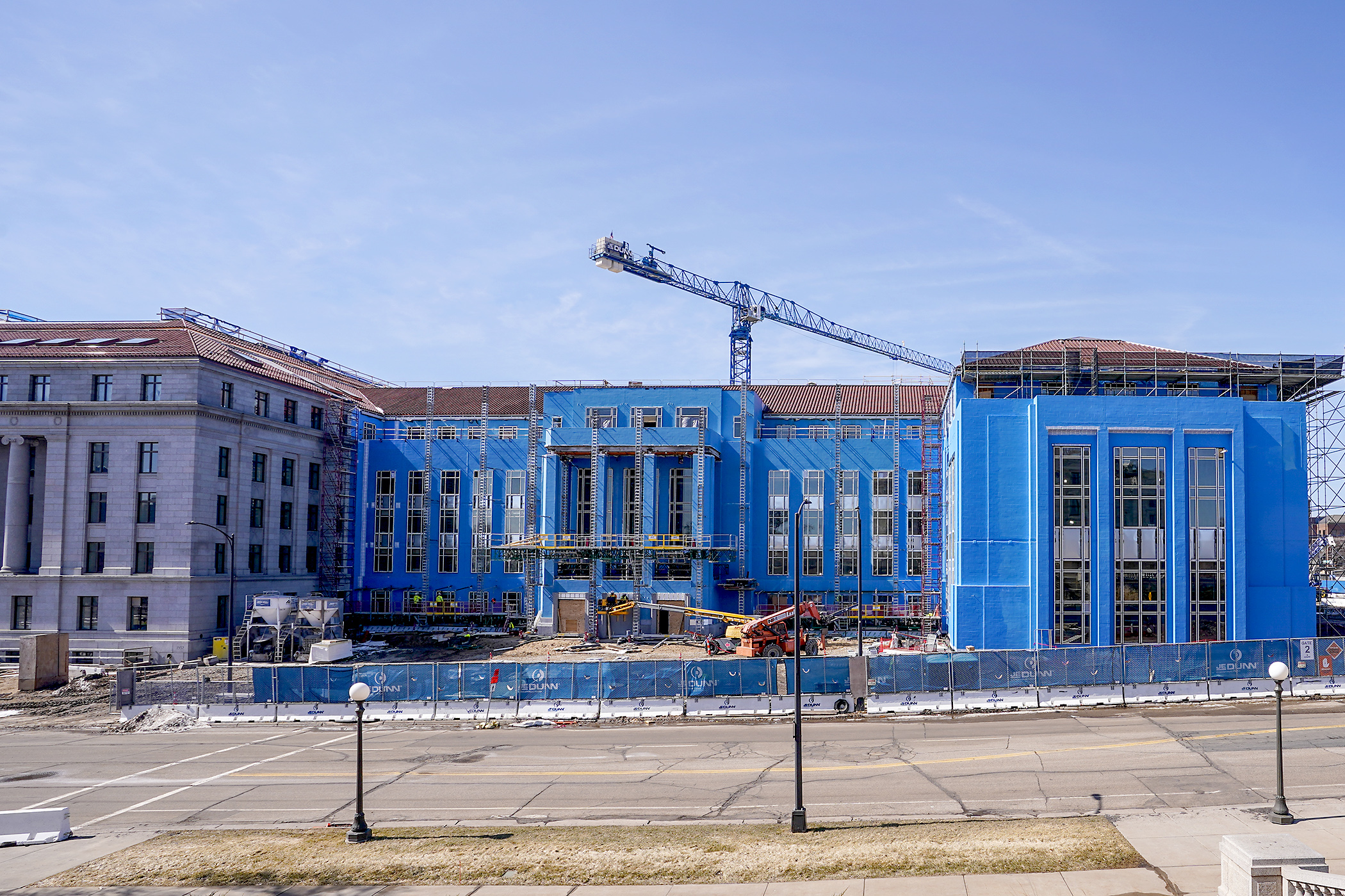
House operations and members are likely to return to a renovated and expanded State Office Building in September 2027.
Once that building is filled, the current home of those individuals could be no more.
According to Department of Administration officials, substantial completion of the State Office Building is scheduled to occur by July 2027 with final building commissioning, cleaning and operational setups for House IT, security and television broadcast occurring in July and August before tenants move in.
“The intent is to make this transition as smooth as possible,” Assistant Commissioner Wayne Waslaski told the House State Government Finance and Policy Committee Tuesday.
Thus far, $507.8 million has been allocated. “We are currently tracking within budget on the project and we are not seeing any overages,” Construction Operations Manager Eric Radel said.
Installation of drywall, ceiling system, flooring, cabinetry and elevators is occurring in the expansion area, along with painting and restroom buildouts. Mechanical equipment start up and testing is expected this summer.
“We’re a little further ahead in the original building than the expansion,” Radel said. “We’re working on painting, flooring, ceiling installation. We’re working on the lightwells or the courtyard atrium spaces on the east and west sides. … We’re working on the loading dock and the stairway link between the parking ramp and building is ongoing as well.”
[MORE: Department of Administration PowerPoint, including before/after pictures]
Sidewalks and the final grading plan are targeted for this summer and fall, with exterior stonework ongoing.
Before construction began, there was talk of a December 2026 completion; however, some site conditions related to the addition led to an increased timeline. The schedule has not changed in the past 18 months or so, Waslaski said.
Will the COB disappear?
In his bonding proposal, Gov. Tim Walz calls for nearly $19.5 million to raze the Centennial Office Building. Built in 1958, the 240,000 square-foot structure is anticipated to be about 30% occupied once the House vacates and, Waslaski said, it has “significant deferred maintenance issues,” citing as an example electrical infrastructure dating to the original construction.
“Do we invest in major renewal of that building, renovation of that building by updating the building systems, or do we proceed with demolition? Our recommendation on that from a cost standpoint is demolition.”
A November 2022 Strategic Facilities Plan is the result of looking at how workforce needs have changed, including remote or hybrid work, and provides an opportunity to look at space needs.
The approach includes promoting space sharing, backfilling open space in state-owned facilities and potentially razing unused or obsolete space, such as the Ford Building in 2024.
Greg Ewig, the department’s senior director of real estate and construction services, said it’s an opportunity “to right-size our footprint” by using state space more efficiently and potentially reduce operating costs.
“The plan continues to serve as a roadmap to making decisions on office space moving forward,” Ewig said.
Thus far, the department has reduced more than 25% of its footprint on the Capitol Complex, the Health Department did not renew a 100,000 square-foot commercial lease, and the Department of Revenue and Minnesota Management and Budget are both down about 20%.
Related Articles
Search Session Daily
Advanced Search OptionsPriority Dailies
Could 2026 retirements lead to record turnover in the House?
By Lisa Kaczke In the final weeks of the legislative session, House members not seeking re-election to the body have taken a turn at gaveling in a floor session.
It’s an opportunity to loo...
In the final weeks of the legislative session, House members not seeking re-election to the body have taken a turn at gaveling in a floor session.
It’s an opportunity to loo...
How short are the Legislature's short sessions?
By Lisa Kaczke Rep. Ron Kresha (R-Little Falls) was ready to end the session March 25, making the motion to adjourn sine die. But not enough of his colleagues shared that sentiment, defeating ...
