 Minnesota Legislature
Mandated, sometimes memorable: A look back at noteworthy State of the State addresses
.jpg)
Gov. Tim Walz is scheduled to deliver his eighth and final State of the State address to 134 representatives, 67 senators, and a handful of other state officials gathered in the House Chamber Tuesday evening.
How will he sum up his term as governor, filled as it has been with so many significant events? What will he highlight? What will he omit?
We won’t know until he begins his farewell speech, scheduled to start at 7 p.m.
Until then, enjoy this Session Daily look back at some of the more memorable State of the State speeches Minnesota governors have made throughout the state’s 167-year history.
Not all addresses are memorable, of course. Although they are guaranteed to set out the general plans a governor has for their term — or what’s left of it — many are run-of-the-mill political stump speeches having no long-term impact.
But a handful have been inspiring, impactful, and motivating, and have significantly uplifted the state of the state and its residents.
We’ll focus on these exceptional State of the State addresses, plus some that have been the opposite, leading to historical injustices staining Minnesota’s otherwise stellar reputation.
A little context
As far the Legislative Reference Library could determine, Gov. Harold LeVander’s 1969 message to the Legislature was the first to be titled “State of the State.”
Prior to that, they were called special messages, inaugural addresses, annual messages, and in the case of the first ever such speech in 1858, a Governor’s Message.
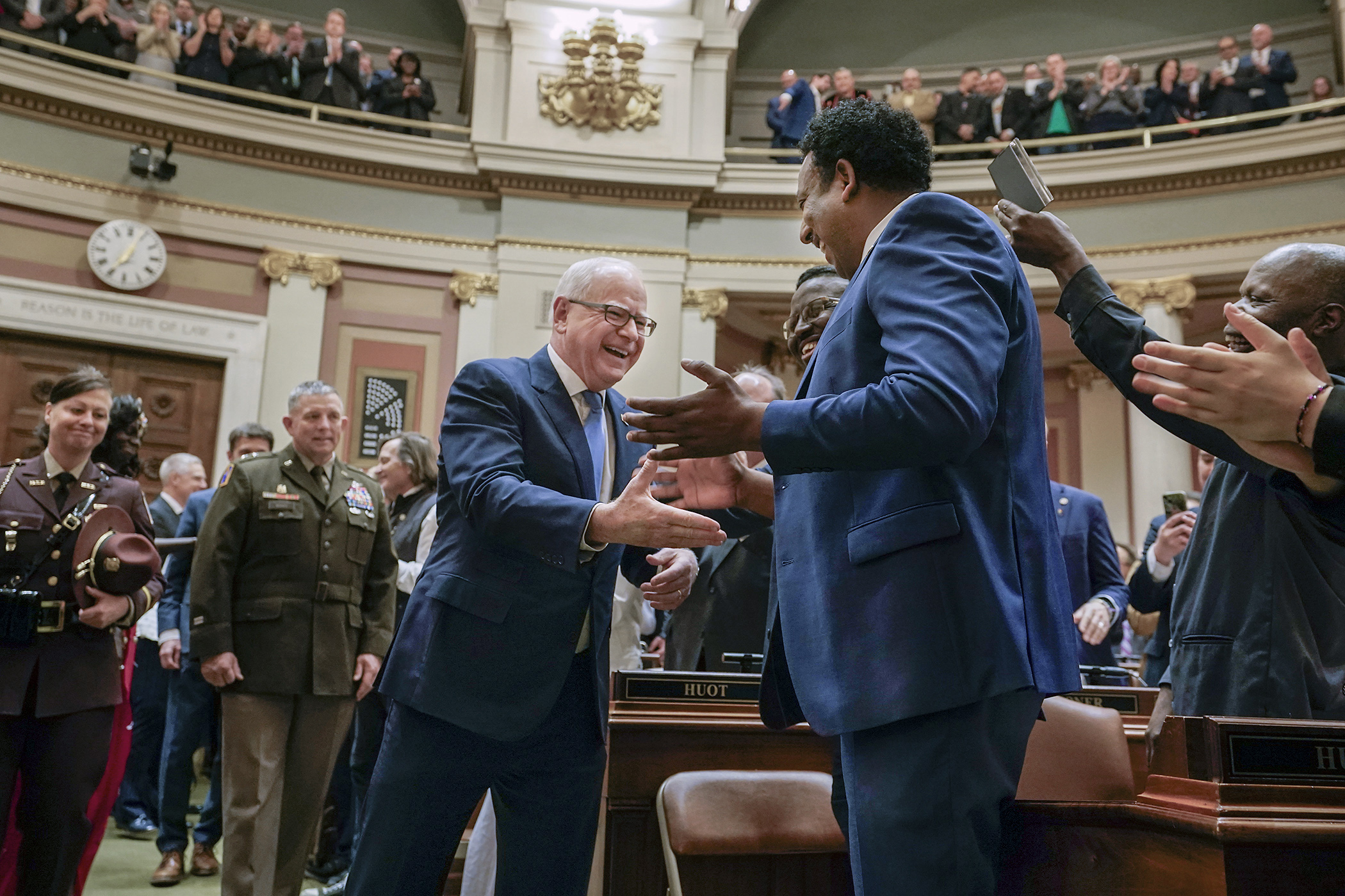 Gov. Tim Walz greets lawmakers as he enters the House Chamber to deliver his 2025 State of the State address. (Photo by Michele Jokinen)
No matter what it’s called, a governor’s address to the Legislature is mandated by Article V, Section 3 of the state constitution, which states, “The Governor shall communicate by message to each session of the legislature information touching the state and country.”
Note that the passage is vague on required content, and does not specify when, where, and how messages need to be delivered — and has no penalty for not delivering one.
Typically such messages are delivered in the House Chamber, but several governors have used this leeway in creative ways.
The first time a governor’s address was given outside the Capitol was in 1983, when Gov. Rudolph “Rudy” Perpich delivered a separate inaugural address at Hibbing High School.
The State of the State has been held outside the Capitol 11 times: twice each at the governor’s residence, in Bloomington, and in Rochester; and once in Hutchinson, Mankato, St. Cloud, Winona, and on the University of Minnesota campus.
Rudolph “Rudy” Perpich
In addition to delivering the first ever State of the State address outside of the Capitol, the 1990 speech by Perpich broke tradition by incorporating a highly unique and emotional segment featuring video messages from Minnesota students sharing their personal struggles with drug use.
It used a television monitor to play video clips of Minnesota teenagers speaking candidly about how drugs had affected their lives, families and academic success.
Perpich used these testimonials to advocate for a massive expansion of the state’s drug education and treatment programs, moving the focus from strictly law enforcement to youth prevention and community support.
That philosophy continues to shape how Minnesota’s criminal justice system deals with illegal drug use today in both juveniles and adults.
Tim Walz
Gov. Tim Walz’s 2020 State of the State address was not delivered to a packed House Chamber of lawmakers at the State Capitol. Rather, for the “Living Room Broadcast” on April 5, Walz was sitting alone at a desk in the Governor’s Residence.
His speech served as a somber call for resilience during the terrifying and uncertain earliest weeks of the COVID-19 pandemic.
Broadcast live to millions of Minnesotans isolating in their homes, the address provided a singular platform for Walz to frame the pandemic response as a collective effort, famously comparing the state’s resilience to surviving long Minnesota winters.
Although the times were dark, Walz said, “We will come out better on the other side of this winter.”
Although his words initially fostered a sense of shared purpose, soon after the address a deepening partisan divide began over Walz’s use of emergency powers. Republican leaders soon began challenging these executive actions, arguing for a return to legislative oversight.
Mark Dayton
Gov. Mark Dayton’s most significant and memorable State of the State address occurred on Jan. 23, 2017, primarily due to a dramatic health scare that unfolded on live television.
More than 30 minutes into his speech, Dayton began slurring his words and collapsed at the podium. He hit his head on the lectern and was caught by Secretary of State Steve Simon before being attended to by paramedics and legislators.
[MORE: Gov. Dayton collapses during State of the State address]
The following day, Dayton, disclosed he had been diagnosed with prostate cancer. Despite the scare, he returned to work immediately.
Jesse Ventura
Former professional wrestler and actor Jesse Ventura shocked the nation in 1998 by winning the Minnesota governorship as a Reform Party candidate.
Ventura used his State of the State speeches as a bully pulpit to bypass traditional politicians and speak directly to citizens. He famously and repeatedly used the addresses to champion a unicameral (one-house) Legislature to eliminate what he called bureaucratic gridlock.
.jpg) Then-Gov. Mark Dayton delivers his 2011 State of the State address in the House Chamber. (House Photography file photo)
Then-Gov. Mark Dayton delivers his 2011 State of the State address in the House Chamber. (House Photography file photo)Although the Legislature never granted him his one-house system, his blunt, non-traditional delivery made every address a major media event.
Except in 2000, when Ventura didn’t deliver a State of the State address at all.
Although never giving a specific reason, Ventura was heavily consumed with national politics by early 1999 and was actively fighting for control of the national Reform Party.
Many lawmakers from both sides of the aisle viewed the decision as showing a lack of respect for the legislative process and a failure to outline a clear policy agenda for the year.
For the general public, however, the reaction was largely a collective shrug, and for his supporters, skipping a stuffy political speech fit right in with his brand.
In any case, whether he gave a State of the State address or not, the unique circumstances of his situation — having both Democrats and Republicans opposing his proposals — meant he had few political victories during his one term as governor.
Wendell Anderson
In 1971, Gov. Wendell Anderson addressed a deeply divided, conservative-leaning Legislature with a bold, revolutionary plan to completely overhaul public school funding by shifting the burden away from local property taxes and onto state sales and income taxes.
Despite initial lukewarm public support — his proposal raised taxes, after all — and strong opposition from Conservatives (as Republicans were called then) his massive tax shift eventually passed after a 157-day special session, the longest in Minnesota history.
The tax changes cemented Minnesota’s reputation for high-quality public education and progressive tax policy for decades and earned Anderson national acclaim for the “Minnesota Miracle,” including an appearance on the cover of Time magazine in 1973 as the face of “A State That Works.”
John Albert Johnson
Although less dramatic than Anderson’s “Minnesota Miracle” tax changes, those proposed by Gov. John Albert Johnson in his 1907 State of the State address resulted in long-lasting impacts that are felt today.
These changes were in line with his Progressive Era bona fides, and his progressive tax reforms brought about significant modernization and fairness to taxation.
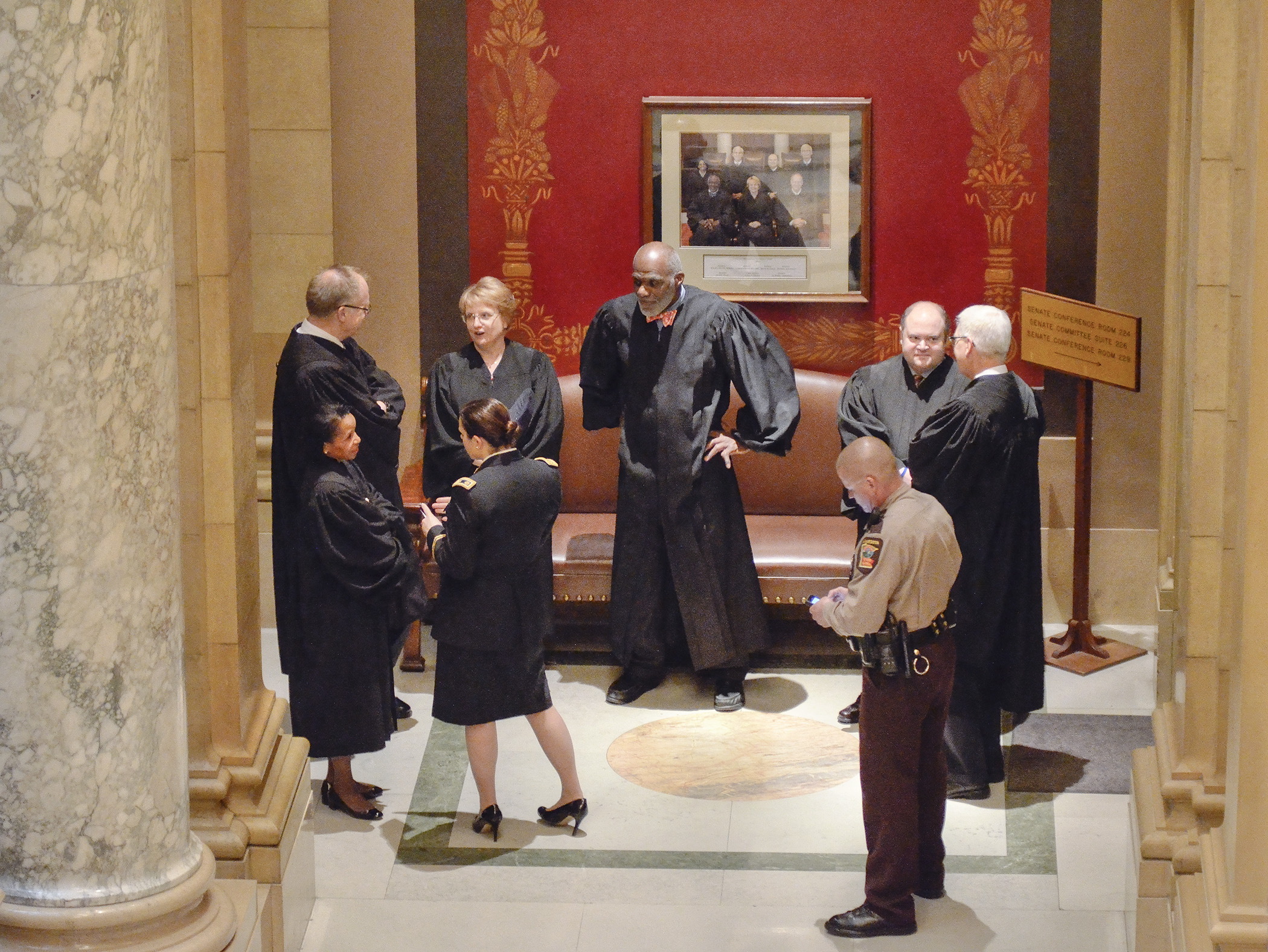 Members of the Minnesota Supreme Court await their entry into the House Chamber ahead of then-Gov. Mark Dayton's address in 2014. (House Photography file photo)
If his State of the State address had a thesis statement, it would be: “The best that this body can do is to equalize as nearly as may be the burden of taxation and so adjust it that its weight will not fall too heavily upon those unable to bear it, and distribute the responsibilities in accordance with the privileges enjoyed under our government.”
As a result of his efforts, a permanent state tax commission was formed to provide professional oversight and more equitable administration of state taxes.
Johnson also successfully advocated for the removal of rigid constitutional restraints on the Legislature’s power to tax. This gave lawmakers far more flexibility to create targeted and fair tax policies.
Karl Rolvaag
Gov. Karl Rolvaag’s 1963 State of the State address was not so much memorable for its content, but for when it was delivered.
The 1962 election was held on Nov. 6, but the results were not known until a 139-day recount was completed in March 1963.
Rolvaag won the closest gubernatorial election in state history, defeating the incumbent, Gov. Elmer Anderson, by 91 votes out of more than 1.3 million cast.
In his April 1 speech, Rolvaag commented on the “anguish” of the preceding five months of the recount, saying Anderson “must have contained an agony which only he can measure and describe.”
“Never have our democratic processes been put to such strain, never have two great political parties been put to such stress.”
Rolvaag sought to heal the state’s post-election political divide by prioritizing humanitarian reforms and educational infrastructure over partisan combat.
Despite facing a hostile, Conservative-controlled Legislature, he was an effective governor because he focused on unifying the state through several initiatives that had bipartisan support, including championing the 1967 Minnesota Fair Housing Act, which prohibited housing discrimination and aligned state policy with the national civil rights movement.
Alexander Ramsey
The second of two addresses Gov. Alexander Ramsey gave to the Legislature in 1862 can be described as notorious. And racist, too. Very racist.
In his first message in January, Ramsey primarily focused on the financial and military strains of the American Civil War.
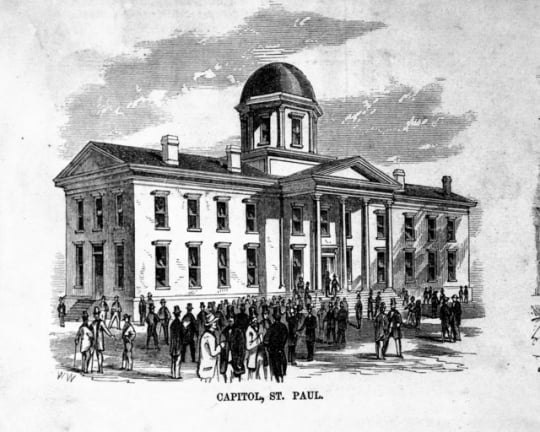 A drawing of Minnesota's first State Capitol. (Image courtesy the Legislative Reference Library)
But in a later, infamous speech delivered during an emergency session in September, he focused on the U.S.-Dakota War — and his dark plans for it.
Ramsey famously declared to the Legislature, “The Sioux Indians of Minnesota must be exterminated or driven forever beyond the borders of the State.”
He characterized Indigenous people as outlaws, arguing that the safety of white settlers required their complete removal or annihilation.
His words set the political groundwork for the mass forced removal and exile of the Dakota people from Minnesota in 1863, and the hanging of 38 Dakota men in Mankato — the largest mass execution in U.S. history.
Henry Sibley
We end this review of memorable State of the State addresses by touching on the speech of Gov. Henry Sibley delivered on June 3, 1858, less than a month after Minnesota achieved statehood.
But there wasn’t much memorable about it, other than it being the first of its kind.
In retrospect, however, one can see with the benefit of hindsight that the most significant portion of his address is his lamentation that “we have warlike tribes of savages on our frontiers,” referring to the Indigenous Chippewa and Dakota/Lakota (he uses the old name “Sioux”) peoples living in the newly admitted state.
In a very prescient passage, Sibley said: “We have likewise a duty to perform in arresting and bringing before the State tribunals, for trial, individuals of the hostile tribes of Chippewas and Sioux who traverse our settlements and destroy each other without mercy.”
Prescient because Sibley’s post-gubernatorial career was as a colonel in the U.S. Army during the Dakota War of 1862, where he set up a military commission to try captured Indigenous warriors in sham trials, some of which lasted only a few minutes.
It was under Sibley’s orders that the Dec. 26, 1862 hanging of 38 Dakota men in Mankato took place.
***
For a compilation of State of the State, inaugural addresses, and other notable governor messages to the Legislature, visit the Legislative Reference Library webpage on the topic.
Related Articles
Search Session Daily
Advanced Search OptionsPriority Dailies
Could 2026 retirements lead to record turnover in the House?
By Lisa Kaczke In the final weeks of the legislative session, House members not seeking re-election to the body have taken a turn at gaveling in a floor session.
It’s an opportunity to loo...
In the final weeks of the legislative session, House members not seeking re-election to the body have taken a turn at gaveling in a floor session.
It’s an opportunity to loo...
How short are the Legislature's short sessions?
By Lisa Kaczke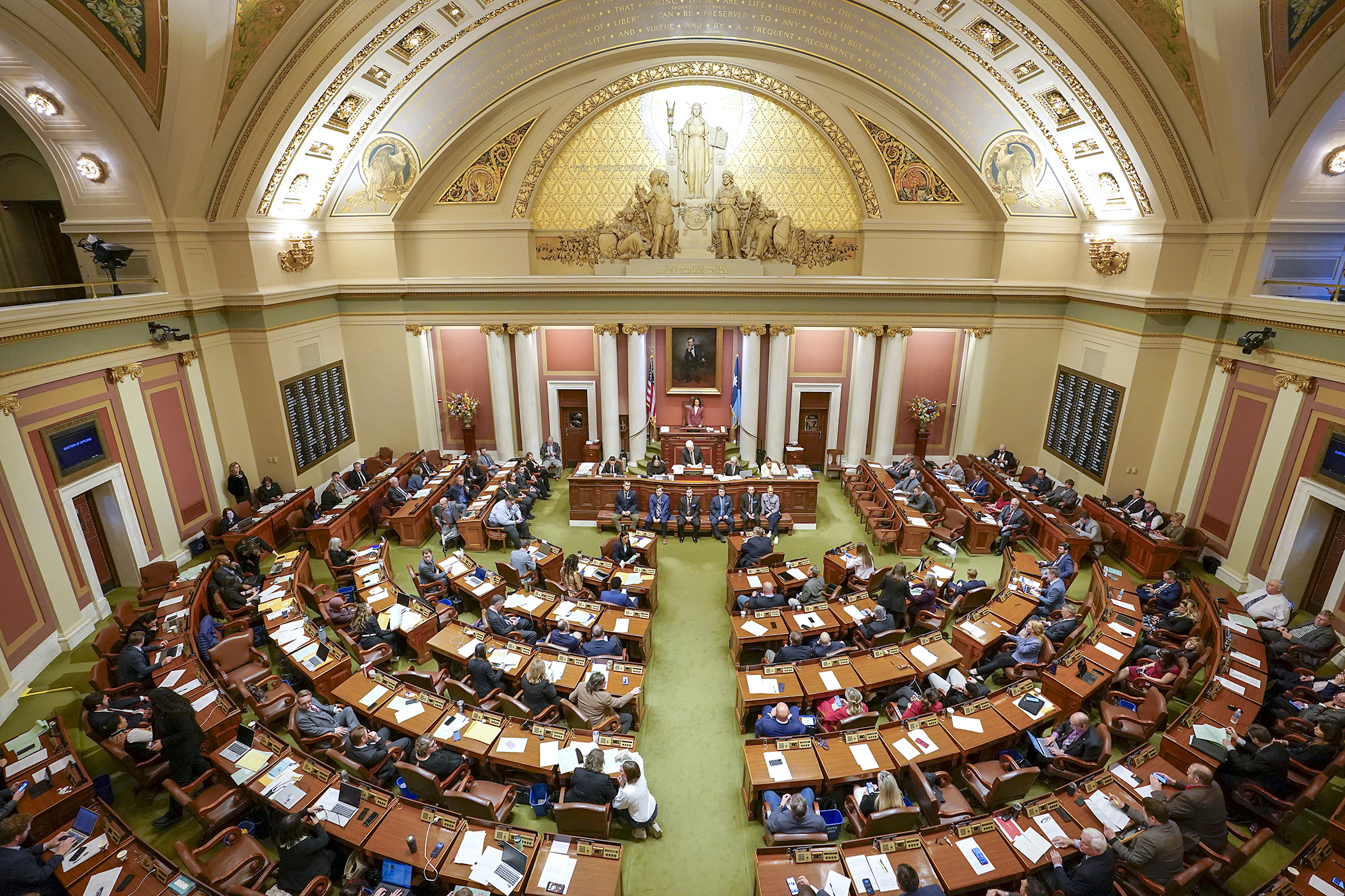 Rep. Ron Kresha (R-Little Falls) was ready to end the session March 25, making the motion to adjourn sine die. But not enough of his colleagues shared that sentiment, defeating ...
